Sunday, December 17, 2006

Abrazos Gratis (Free Hugs) in Chile

So this past weekend I went to Chile and this was only a few days after Pinochet died. In the same street you could find people crying and other people popping open bottles of champagne to celebrate the death of the 'asesino.' I walked through the center of Santiago and ended up following a protest against the sexual exploitation of children.
As I walked through the protest I saw a woman holding up a sign saying 'abrazos gratis' free hugs and hugging people who came up to hug her. There were about three of them with these signs so I asked her what it was all about. She told me its simply just a way to be cool with people and its part of a global campaign to just give hugs because there are days when people want to be hugged and have no one to hug them or when people want to hug somebody and don't have anybody to hug. She asked me if I wanted a sign so I said okay no problem.
I held up the sign and the first guy who hugged me started crying and told me that he had just lost his job. And I thought wow, thats pretty sad. Then the second was an old lady who hugged me and thanked me because she said she really needed it and I thought "man people in chile really need some love." Then of course, little children ran and hugged me and grabbed my hair because they had never seen dredlocks on somebody that looks like me before so that was fun for me but NOT for my dreds. Anyway, when a couple shady guys started hugging me I gave up the sign and thanked her for letting me participate.

Then I thought, what would've happened if this were done in Jamaica?

Here are some of the responses I would probably get from stereotypical Jamaican men if I held up a free hugs sign in Half-Way-Tree.

1."Den baby yuh neva need no sign!"
2."So no free kiss nah give out too?"
3. "Yuh can give me yuh numba so me can hug yuh lata?"

4. "Yuh sure is jus a hug yuh need? me can give u more tings u nuh..and it would be for free still baby."
5. "So yuh fren nah give out no free hug too?"

Yep, there would be a lot of groping going on in Half-Way-Tree if the free hugs campaign ever made it to Jamaica.

Gender and Stand-up Comedy

Political Humour as it exists through stand-up comedy operates in a public space that becomes a contact zone between individuals and institutions of power. In many ways, within that public space, marginalized people can talk back and the comedian functions as mediator. In other moments he or she reinforces social norms and participates in the perpetuation of notions/beliefs we have about each other.
So for example, when I was in Nicaragua, their stand-up comedian Luis Enrique Calderón (and yes there is only one) was known as the grand imitator of several politicians and public figures. Not only did he mock them and their policies but he also had a question and answer session in his routine where the audience engaged with him and the personaje he created in order to produce comedy. The questions the audience posed were usually about scandals that the public knew that the politicians would deny. So questions would range from 'is it true that, how can I ask this..hmmm did you sleep with so and so? to '...what happened to the 6 million dollars you were gonna use toward...?' and responses would range from 'the question is not did I sleep with...its who DIDNT sleep with so and so' and 'yeah, I've been looking for those 6 million dollars too...'
In circumstances such as the one above, stand-up comedy becomes a space in which criticisms of the ruling class are made visible, silences are broken and the reaction of the common people is made public. In this way, the comedian both creates and mediates a space where people can talk back and therefore, he/she gives them voice. This is important because there is a gap between 'public figures' and 'common folks' where people do not have access to the president or a politician. So the simulation between the comedian and the audience intends to change that.
This is one side of stand-up but there is a way in which Stand-up comedy can also be about the reinforcement of social 'norms' about gender, sexuality, race etc. What I am seeing now of stand-up comedy in Argentina is that it often draws upon and reinforces social norms to make people laugh.
So a cartoonist Demetrio Lopez from “El Mosquito” told me that female comedians and male comedians talk about different things. He said “los hombres hablan sobre lo que pasa y las mujeres hablan sobre lo que les pasa a ellas” Men talk about what happens while women talk about what happen to them…He continued “Las mujeres hablan sobre cosas femeninas mientras que los hombres te pueden hablar de cosas 'normales' como la economia no..?” Women talk about feminine things while men can talk to you about the economy etc. Now anyone who knows me will know that my own feminist ideologies strongly disagree with him so I want to describe what happened yesterday when I went to a stand-up comedy show.
It was a meeting of many cartoonists, comedians and writers to celebrate the publication of a new comedy supplement “El Mosquito” in Argentina and after a discussion about the state of humour today and fifty years ago, four comedians: two men and two women did stand-up comedy routines.
Here are all of the opening jokes from their routines:
The first male comedian started his routine by saying. “Hoy mi mujer me sirvió desayuno en la cama, yo empujé la cama hacia la cocina y me dió el desayuno” “Today my woman served me breakfast in bed, I pushed my bed to the kitchen and she gave me my breakfast”
The Second Male comedian started his routine: Ayer mi mujer me dijo que está embarazada y yo dije “en serio?” me dijo “si, felicidades sos tio! Yesterday my woman told me that she is pregnant and I said, “really” and she said “yes, congrats, you’re an uncle.”

The first female comedian “Chicas, hay sólamente dos tipos de hombres “el que te quiere coger y el que ya te cogió...y basta. Sí, es que es tan sencillo,” Girls, there are only two types of men, those that want to f---k you and those that already f---ked you…and that’s it…yes, its just that simple.
The second female comedian said: “¿Miren, ustedes han visto esas publicidades en que la mujer intenta comer el chocolate y el hombre se lo quita la mano de ella y la ofrece una pastilla de dieta...y ella SONRIE?!?..mire...si un hombre me hace eso...lo matare! Que tengo hambre idiota!" Hey, have you guys seen those ads with the woman trying to eat the chocolate and the man pushes her hand away and offers her a diet pill....and SHE SMILES??? Look, if a guy does that to me...I will kill him! I'm hungry you idiot!

Each comedian begun their routine with some statement alluding to habits, stereotypes or events with the person of the opposite gender. It is not true that women talk about gender and men don't. They speak about gender in different ways. It is not a coincedence that these jokes happen nor is it just natural that a man or a woman would talk about these things. These jokes are supposed to be things that are believeable and most importantly, things that the audience is supposed to identify with.
So what are the notions about gender that are at play: one is the image of the woman who is watching her weight and the man ensuring that she sticks to her diet. What a perfect patriarchal image right? Then there's the notion that all men just want to have sex with you because that is the way that patriarchy defines manhood. If the comedian had switched genders and said that 'there are only two types of women: one that wants to... and one thats already...' it just wouldn't be that believable would it? Then there is of course, ideas about social institutions i.e the bad marriage ideology at work...the cheating wife or the 'I can't be bothered to really serve you in bed anymore' one which is really identifying a marriage thats losing its steam. Calling upon notions about gender and social institutions is important for the comedian because it allows him/her to connect with the audience. Comedians' explanations for this is that comedy is supposed to reflect social reality not change it. Stand-up comedy is a mirror to what happens in the day to day life of ordinary people.
Now I think this is true to some extent but I want us to return to the final joke I posted about the woman talking about the ad, 'the I'm hungry you idiot!' line. For me, I thought that this joke went against what has been constructed as normative. The notion that a woman is more worried about her body image than eating when she's hungry. It was interesting to me because it wasn't a fat comedian saying it, she was slim and in shape so she wasn't using her weight to make the joke funny. What I felt like that female comedian did in that instance was to challenge the notion that it is okay to tell her to watch her weight. In essence, she made a criticism of how the media feeds us (no pun on feed) with how we ought to behave and how women supposedly look at our bodies. For me, in that instance, the 'norm' was broken and more power to her for it because her joke basically said, "listen thats just dumb that they are telling us that we can't eat whatever we want and that we need to watch our image and if you mess with me like that, dude, I might just murder you." What I am curious about is whether or not a woman like that is therefore constructed as less desirable or as a glutton? It could be. But for me, it was an instance where social norms were challenged and reveals that a comedian chooses to reinforce or to challenge social norms. So if stand-up comedy is supposed to be a mirror, then it is the comedian who decides what is being reflected because he/she does not exist outside of social reality. Social change through stand-up comedy can only happen when a comedian decides that he/she wants it to happen.
©Danielle Roper

Monday, December 11, 2006

fav quote from gay pride rally in Buenos Aires

"Saca tu rosario de nuestros ovarios"
Take your rosary out of our ovaries
--Gay Rights Advocate speaking on abortion

Tuesday, November 28, 2006

Comedy at its Worst

I chose to study Political Humour and Social Transformation because I truly believe that it can be a space for marginalized people to speak out and that Humour can be an instrument of change. However, like every profession, the comedy industry is not immune to society’s inequities and comedians often have to buy into prejudices or stereotypes about certain groups of people to be successful. An Argentine cartoonist, Daniel Paz told me that in order for a joke to be funny, it must be based on a common social norm or assumption that everybody shares. So if you want to make a joke about your mother-in-law, you have to use all the stereotypes and associations that the public has about the mother-in-law in order for the joke to be funny. Basically, a joke requires that you use notions about gender, race and sexuality so that people can laugh. He told me that a joke is always a result of a cultural, social, and political context as well as the ideological norms of any given society; And the comedian must know this to make people laugh. Comedians themselves are not immune to having racist, sexist or homophobic views of different groups of people. So when Mr Paz told me this, I knew he was right but when I saw Micheal Richards' (Kramer from Seinfeld) racist outburst at a gig at a local comedy club, I thought, geez, did he really have to be that right about it?
Find video below:


Now the question is not whether or not his outburst was racist, I mean that goes without saying right? Like duh! But what is important to consider is that he felt that he could say it. That outburst probably would not have happened had he been performing in front of an all black audience or if the owners of the club were black. Kramer felt that the comedy club as a public space was a white space that belonged to him and other white people. So the intimidation and attack on the black man is not just a personal feud between two individuals at the comedy club, it is the establishment of his authority and control over a public space that must only be accessible to whites. The ‘interruption’ of the black man at the comedy club is more than a distraction in a comedy routine; The black man’s mere presence is an intrusion upon a white hegemonic public space and a public threat to Kramer’s white authority over that space.
Perhaps the most obvious display of white solidarity and privilege is the fact that the owners of the club allowed him to perform the very next day and have not released the official copy of the video showing his entire performance. Had a member of the audience not videotaped and leaked it out, we probably would not have known about it. The comedy club’s position or their failure to publicly take a position on the issue is important because Kramer as a performer is also representing them. A comedy club is a business which has policies about what can and cannot be said at their show so not taking a stance or remaining silent is to endorse his racist behaviour.
However, let us not forget that there were white people who walked out at the performance and who were also disgusted by his behaviour. So it is not that all white people sat there in support or his racism, there were those who allied themselves with the people of colour in that moment.
Lets take a look at his apology:


There are several problems with the ‘apology’: 1. He has not come out to the media himself and apologized. Why is Seinfeld giving him the opportunity to do so? Is it not Michael Richard who should have come forward and done it himself? 2. The terminology of the apology: Who are Afro-Americans? At any rate, African-Americans are not a ‘community’ they are individuals and ought not to be clumped into one group. Also, given that they are citizens like everybody else, he as a public figure with fans etc, owes the Black man and the public an apology for his actions. 3. The ‘I’m Not even a Racist remark.’... I won’t elaborate on this, I think you all get it.
Additionally, given the laughter from the audience and then the thunderous applause after his apology, it is safe to say that his apology is not being taken seriously and has prompted no real discussion about his racism.

But what about what the African Americans had to say:

African American response:


What I think is of most importance, is that a white woman is defending the African Americans in this scenario. This is important because white women have a long history of functioning as/positioning themselves and being positioned by white men as mediators between people of colour and white people. So if you watch a movie like King Kong, which is really a conversation about civilization and barbarianism where civilization- read white, refined city etc- defeats barbarianism- read gorilla/animal with black cannibal natives from the wilderness- you’ll notice that it is a white woman who is kidnapped by the gorilla and who understands him in the end of the movie. A white woman in that movie as mediator and investigator of the ‘unknown’ or ‘incomprehensible’ becomes the site of negotiation between the powerful and powerless who does not have the legitimacy to speak for himself. In this scenario, two black men with a white female lawyer mirrors King Kong to me because she as mediator is speaking for the black man who has no authority to speak for himself. Don’t get me wrong, it is strategic to have a white woman represent the black man because it shows that white people were impacted too and that white people stand in solidarity with people of colour. However, it also falls into an endless cycle where in order for black people to challenge white authority they cannot do it directly, they must be spoken for or represented by a white person. What is a stake is who has the authority and the legitimacy to directly challenge white privilege and in this scenario, blacks do not possess such authority.

I also want to comment on the fact that one of the black guys in his interview on the Today Show referred to Latinos as Mexicans. When are we going to get with the program and realize that all Latinos are NOT from Mexico and should NOT be referred to as Mexicans? They are LATINOS! While it is true that they (the African-Americans)have internalized stereotypes about Latinos, their own prejudices do not have the same systemic impact that white prejudice has because they live in a white dominated society. This doesn’t mean that clumping Latinos is okay, it just means that it does not have the same impact.
Similarly, calling Kramer a ‘cracker’ at the show is not okay either but given the fact that racism as a system that historically and presently privileges white people and oppresses people of colour, black prejudices do not have the same consequences for whites. In other words, blacks also have their own prejudice against white people but do NOT possess the power to enforce that prejudice in a systematic way.

Perhaps the biggest problem with this horrific display of anti-black racism is that no one sees it as the display of a larger problem: systemic and systematic racism. Micheal Richards/Kramer has internalized prejudices against black people but we only acknowledge that racism exists when hate speech occurs. Even though statistically, people of colour do not have equal economic, social and political access we only think America has racism when white people use racial slurs or epithets. So the conversation switches to why all comedians should stop saying 'nigger' and 'bitch' without thinking about how a whole system is set up that privileges whites and disadvantages people of colour. The discussion on hate speech is not about dismantling white privilege in a systematic way, it is about making that privilege less visible. So we end up thinking when hate speech stops then racism no longer exists instead of thinking how can we dismantle the myth of the meritocracy.
©Danielle Roper

All videos coutesy of www.youtube.com

Point of interest:
Check out the latest article about the killing of an unarmed black man by police officers before his wedding: http://la.indymedia.org/news/2006/11/189611.php

Favourite Quotes from Erick and Keya during their stay in Buenos Aires

Erick describing red tango shoes:"Toto we're not in Kansas anymore"

Keya: Dude, Oprah is so unfortunate looking...
Erick, the inside of my nostrils and I describing unfortunate looking:


Erick:Dang, Life is REAL in Injah

Wednesday, November 22, 2006

Argentinian hospitality

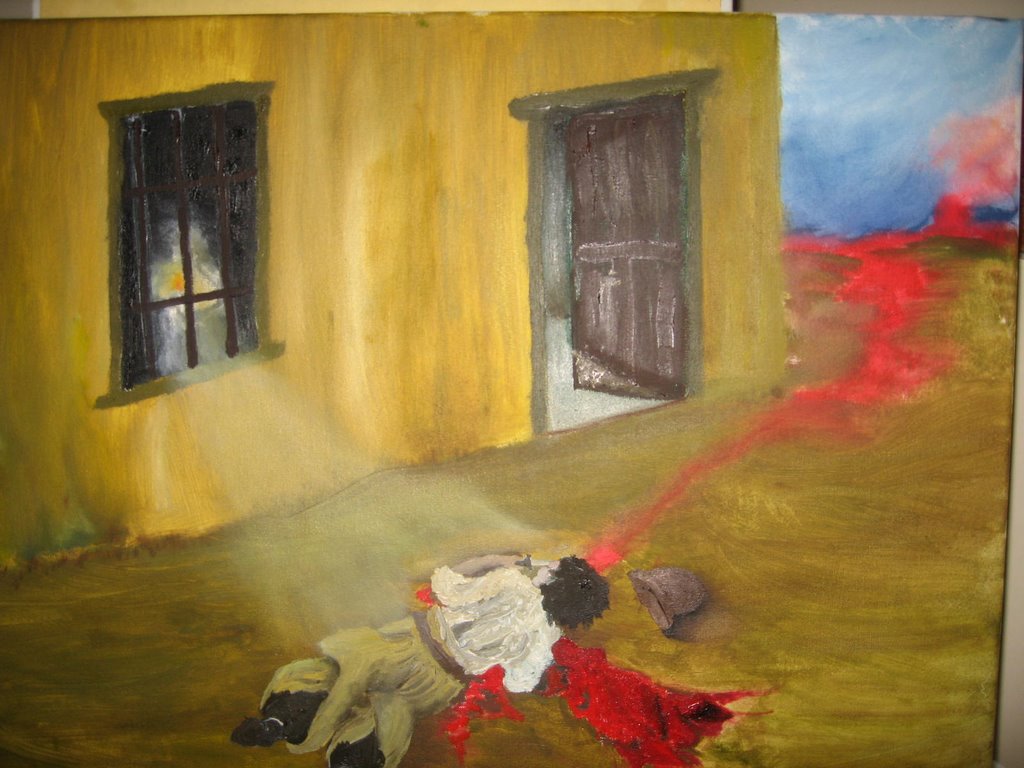
So when I got to Argentina, I spent the first night with Johanna at her señora's house. So she said to me: Hey do you know that my señora is a painter and wants to give me one of her paintings before I leave"
As she says this I look across the room and see the painting below


Then Johanna goes: I don't think my señora likes me very much
Me:Johanna...she doesn't dislike you..she wants to kill you

An Indian, Jamaican and Gay Cuban watching a man and woman dancing Tango in Argentina

Keya (The Indian): Wow, that woman has such great posture. Tango is such a sensual dance..
-Danielle (the Jamaican): Yeah, it really requires so much grace and practice to do this dance...
-Erick (gay cuban):That guy must use a lot of shampoo!

Jamaican and Indian Response: ??????