Here are the list of petnames my host family calls me in the house:
Wawachay -My little baby- This is especially used when I'm hungry.
Juk'ucha-Rat. This is used when I don't finish my food.
Munay Sipas--Pretty young girl. This is used when I finish my food.
Yunk'u--Kiss ass or suck up. This is used when I am trying to convince Doña Petra to give me something I want.
Umasapa--Big head. This is used when I'm rude. So I hear this one very often.
Huch'uy sikiyoq kanki--You have a small ass. This is said arbitrarily to me at any hour of day. I still don't know why.
Sunday, August 08, 2010

Saturday, August 07, 2010
Collection of my favourite quotes
1. When my mother landed in Bolivia I took her straight home. Doña Petra was thrilled to meet her. She asked me jokingly in Quechua if now that my mother was here I was going to drink breast milk instead of eating her cooking. The word for "teta" (breast) in Quechua is chuchhuy.
My mother said out loud [in English], "oh wow that word sounds like "chupi-chupi."
Everyone in the room gasped.
I replied, "No Mommy. That's big vagina."
My mother's first words in Quechua were "chupi-chupi-- big vagina". Well done Mommy! You might want to keep that to yourself though next time.
Doña Petra interjected "Y bien lo ha dicho también." [And she said it so well too].
2. My mother starts removing items of clothing at the dinner table. Doña Petra asks, "¿Tienes calor? Como vienes de Jamaica, pensaba que ibas a tener mucho frío acá en Cochabamba. [Are you hot? Since you're coming from Jamaica I thought you would be very cold here in Cochabamba]
My mother replies, "No, no. Solo es la menopausia" [No, no. That's just menopause].
3. One of the students that lived with my host family five years ago came to the house with his Peruvian girlfriend to visit. They hadn't seen him in forever. His girlfriend was not as easy on the eyes as he was and her personality was not as memorable as his is. (I know: euphemism to the rescue). My host mother Doña Petra said that she waited for him to come at 5am and then: " Pero cuando salió con la chica [but when he came out of the car with his girlfriend] (insert LOUD GASP here)....AYYYYYYY [Shaking her head] Quieta me he quedado. [I was speechless]"
You don't know how hard it is for my host mother to be speechless.
When my mother saw her she said, "Danielle, I wonder if she obeah him?" [I wonder if she has used witchcraft to get him.]
Later on when they had the goodbye party for him. My host mother was completely drunk and she said to him sadly, "Te quiero. Pero ayyyy! (Shaking her head) La mejor carne...la ha comido la perra". [I love you. But AYYYY! (Shaking her head) The best meat has been eaten by the female dog.]
In case you miss the reference here, the best meat is him and the female dog is the girlfriend.
Say it with me:WOW!
Hmm Do you think she was a hit with the family?
Favourite quote: La mejor carne...(Shaking head) la ha comido la perra. (The best meat has been eaten by the female dog).
My mother said out loud [in English], "oh wow that word sounds like "chupi-chupi."
Everyone in the room gasped.
I replied, "No Mommy. That's big vagina."
My mother's first words in Quechua were "chupi-chupi-- big vagina". Well done Mommy! You might want to keep that to yourself though next time.
Doña Petra interjected "Y bien lo ha dicho también." [And she said it so well too].
2. My mother starts removing items of clothing at the dinner table. Doña Petra asks, "¿Tienes calor? Como vienes de Jamaica, pensaba que ibas a tener mucho frío acá en Cochabamba. [Are you hot? Since you're coming from Jamaica I thought you would be very cold here in Cochabamba]
My mother replies, "No, no. Solo es la menopausia" [No, no. That's just menopause].
3. One of the students that lived with my host family five years ago came to the house with his Peruvian girlfriend to visit. They hadn't seen him in forever. His girlfriend was not as easy on the eyes as he was and her personality was not as memorable as his is. (I know: euphemism to the rescue). My host mother Doña Petra said that she waited for him to come at 5am and then: " Pero cuando salió con la chica [but when he came out of the car with his girlfriend] (insert LOUD GASP here)....AYYYYYYY [Shaking her head] Quieta me he quedado. [I was speechless]"
You don't know how hard it is for my host mother to be speechless.
When my mother saw her she said, "Danielle, I wonder if she obeah him?" [I wonder if she has used witchcraft to get him.]
Later on when they had the goodbye party for him. My host mother was completely drunk and she said to him sadly, "Te quiero. Pero ayyyy! (Shaking her head) La mejor carne...la ha comido la perra". [I love you. But AYYYY! (Shaking her head) The best meat has been eaten by the female dog.]
In case you miss the reference here, the best meat is him and the female dog is the girlfriend.
Say it with me:WOW!
Hmm Do you think she was a hit with the family?
Favourite quote: La mejor carne...(Shaking head) la ha comido la perra. (The best meat has been eaten by the female dog).
Evo and the Water Wars in Cochabamba
As my time in Bolivia comes to a close, I wish to chronicle some of the criticisms of the Evo Morales MAS government I have heard in my conversations with Bolivians and to also outline some of the problems surrounding the social movements in Cochabamba particularly as it relates to the water wars. My arguments below are in no way based on extensive research; they are simply detailing my own observations and the critiques of the Bolivians I live and study with, Ph.D students from abroad studying politics and the water wars in Bolivia, former revolutionaries who have been tortured in the 70s and 80s as well as Bolivian feminists and Marxists. All of these people politically identify on the left.
Outside Bolivia, Evo Morales is idealised by those on the left for his socialist, anti-imperialist rhetoric and his celebration of Andean culture and way of life. However, many of the Quechua people living in the Barrio have criticised him for his co-optation of Andean discourse and values as a political strategy. According to them, he blends much of Quechua and Aymara philosophy in ways that dangerously conflate contrasting and complex principles of Andean culture. Suddenly diverse indigenous practices and philosophies have been collapsed as one Andean culture/way of life in the public political discourse. Moreover, while he adopts Andean philosophy --particularly PachaMamaism/Love of Mother Earth-- in his political platform, he simultaneously panders to the business groups seeking to extract and exploit the natural resources and labour of indigenous communities. The exploitation of Bolivia's natural resources to capitalist ends are completely incompatible with the principles of Pacha Mamaism. In fact, the very indigenous people who voted for Evo have come out in numbers across the Andes against his attempts to extract the country's natural resources and displace thousands of indigenous people in the last few months.
Secondly, while Evo enjoys overwhelming support of much of the indigenous working class, many middle class Quechuas like my host family feel alienated by him and feel that he only represents and governs for indigenous people of a certain class. The difficulty however, I have had with their argument is that it is often filled with clear classist underpinnings. They support another indigenous candidate Felix Patzi who is middle-class, fully educated, published and and juxtapose him with Evo who they feel is a "poor, ignorant campesino". I am suspicious of their claims that Evo is just "not educated enough" nor does he speak Spanish "well enough" to be president. These arguments emerge out of a colonialist paradigm and linguistic hegemony that declare Spanish as the language of the "civilised" and the "superior". Needless to say I am somewhat skeptical about the intention of the argument itself. However, I will concede that Evo is forced to carry a burden of representation that fixes indigenous people as belonging to a certain class--the campesino class-- and erases the fact that there are indeed middle-class, educated, indigenous people.
Another point of interest is the water wars and the state of social movements in Bolivia under Evo's ruling party. In the international scene the water wars in Cochabamba have been praised as a moment of triumph for the will of the people. However, from what I am seeing on the ground and through my conversation with Anna a ph.d student from Whales studying the water wars in Cochabamba, I have come to see a completely different picture. First of all, people in Zona Norte have full and complete access to running, clean water. People in the Zona Sur do not. The MAS government has sanctioned the social movement fighting for water wars but members of that movement are forced to go to at least three meetings a week. Failure to attend these meeting will result in a fine of 10 bolivianos. This fine is also extended to those who fail to attend the rallies and protest whose images we see proudly being displayed in the local and international media. I am not kidding. To what extent are these people voluntarily protesting if they will be fined for not showing up? If this is not a clear example of co-optation of social movements by Evo's government, I don't know what is.Instead of licensing the movement itself, forcing people to fight for the right to access to running water and fining them if they do not show up, why doesn't MAS just give the people from Zona Sur the access to running water that has already been granted to the people living in Zona Norte? Why not just set up the same/similar mechanisms that are in place in Zona Norte in the Zona Sur? Anna has explained that the difficulty is building the infrastructure to reach the Zona Sur as its geographical layout is very different from the Zona Norte. While the umbrella group has done a good job of getting funding from Europe and has provided access to some parts of the Zona Sur, there is still a lot more work to be done. Moreover, the most marginalised groups of people still do not have access to running water.
Also while the water wars stopped those in power from making the changes they wanted to make, none of the people in authority at SEMAPA controlling water distribution for Cochabamba was fired or replaced. With the same authorities in power and no new policy put in place, no real structural change has actually taken place concerning the water problem in Cochabamba. It is the communities who have been forced to unite and to figure out how to get access to running water in their barrios on their own. I don't know what has come out of these alternatives but I have often seen people in Plaza Colón stealing water from the fountains with buckets when the police aren't looking. Needless to say, the problem is far from solved and the war definitely has not been won. Something more needs to be done on the structural level.
These are just critiques from my small observations and anecdotal evidence from the people I have spent much of my time with Bolivia. I do not know how much of what they say is true. However I will say that there needs to be a more critical approach to Evo Morales and the MAS government from those of us on the left outside of Bolivia. There is certainly a lack of real critical engagement on our part and a romanticisation of Latin America's first indigenous president. Such romanticisation prevents us from critically engaging in/with the struggle for equality in Bolivia and ultimately from working in solidarity with those on the front lines.
Outside Bolivia, Evo Morales is idealised by those on the left for his socialist, anti-imperialist rhetoric and his celebration of Andean culture and way of life. However, many of the Quechua people living in the Barrio have criticised him for his co-optation of Andean discourse and values as a political strategy. According to them, he blends much of Quechua and Aymara philosophy in ways that dangerously conflate contrasting and complex principles of Andean culture. Suddenly diverse indigenous practices and philosophies have been collapsed as one Andean culture/way of life in the public political discourse. Moreover, while he adopts Andean philosophy --particularly PachaMamaism/Love of Mother Earth-- in his political platform, he simultaneously panders to the business groups seeking to extract and exploit the natural resources and labour of indigenous communities. The exploitation of Bolivia's natural resources to capitalist ends are completely incompatible with the principles of Pacha Mamaism. In fact, the very indigenous people who voted for Evo have come out in numbers across the Andes against his attempts to extract the country's natural resources and displace thousands of indigenous people in the last few months.
Secondly, while Evo enjoys overwhelming support of much of the indigenous working class, many middle class Quechuas like my host family feel alienated by him and feel that he only represents and governs for indigenous people of a certain class. The difficulty however, I have had with their argument is that it is often filled with clear classist underpinnings. They support another indigenous candidate Felix Patzi who is middle-class, fully educated, published and and juxtapose him with Evo who they feel is a "poor, ignorant campesino". I am suspicious of their claims that Evo is just "not educated enough" nor does he speak Spanish "well enough" to be president. These arguments emerge out of a colonialist paradigm and linguistic hegemony that declare Spanish as the language of the "civilised" and the "superior". Needless to say I am somewhat skeptical about the intention of the argument itself. However, I will concede that Evo is forced to carry a burden of representation that fixes indigenous people as belonging to a certain class--the campesino class-- and erases the fact that there are indeed middle-class, educated, indigenous people.
Another point of interest is the water wars and the state of social movements in Bolivia under Evo's ruling party. In the international scene the water wars in Cochabamba have been praised as a moment of triumph for the will of the people. However, from what I am seeing on the ground and through my conversation with Anna a ph.d student from Whales studying the water wars in Cochabamba, I have come to see a completely different picture. First of all, people in Zona Norte have full and complete access to running, clean water. People in the Zona Sur do not. The MAS government has sanctioned the social movement fighting for water wars but members of that movement are forced to go to at least three meetings a week. Failure to attend these meeting will result in a fine of 10 bolivianos. This fine is also extended to those who fail to attend the rallies and protest whose images we see proudly being displayed in the local and international media. I am not kidding. To what extent are these people voluntarily protesting if they will be fined for not showing up? If this is not a clear example of co-optation of social movements by Evo's government, I don't know what is.Instead of licensing the movement itself, forcing people to fight for the right to access to running water and fining them if they do not show up, why doesn't MAS just give the people from Zona Sur the access to running water that has already been granted to the people living in Zona Norte? Why not just set up the same/similar mechanisms that are in place in Zona Norte in the Zona Sur? Anna has explained that the difficulty is building the infrastructure to reach the Zona Sur as its geographical layout is very different from the Zona Norte. While the umbrella group has done a good job of getting funding from Europe and has provided access to some parts of the Zona Sur, there is still a lot more work to be done. Moreover, the most marginalised groups of people still do not have access to running water.
Also while the water wars stopped those in power from making the changes they wanted to make, none of the people in authority at SEMAPA controlling water distribution for Cochabamba was fired or replaced. With the same authorities in power and no new policy put in place, no real structural change has actually taken place concerning the water problem in Cochabamba. It is the communities who have been forced to unite and to figure out how to get access to running water in their barrios on their own. I don't know what has come out of these alternatives but I have often seen people in Plaza Colón stealing water from the fountains with buckets when the police aren't looking. Needless to say, the problem is far from solved and the war definitely has not been won. Something more needs to be done on the structural level.
These are just critiques from my small observations and anecdotal evidence from the people I have spent much of my time with Bolivia. I do not know how much of what they say is true. However I will say that there needs to be a more critical approach to Evo Morales and the MAS government from those of us on the left outside of Bolivia. There is certainly a lack of real critical engagement on our part and a romanticisation of Latin America's first indigenous president. Such romanticisation prevents us from critically engaging in/with the struggle for equality in Bolivia and ultimately from working in solidarity with those on the front lines.
Tuesday, July 20, 2010
¿Anos?
I needed an extension of my visa to stay in Bolivia so I went to immigration. A guy from Holland was standing in front of me in the line. The immigration officer asked him, "¿Cuántos años tienes? [How old are you?]
The Dutchman replied, "Tengo 27 anos." 'Años' in Spanish is years but 'ano' is anus. He had said, "I have 27 anuses."
The immigration officer smiled and replied dryly, "Ah ¿sí? ¿Tantos tienes!? ¿Y en dónde los guardas? Sabes qué, no se lo voy a contar a nadie. No te preocupes." [Really? so many! And where do you keep them? You know what, I am not going to tell anyone. Don't worry!]
The Dutchman looked on in confusion.
Oh the beauty of learning a language!
The Dutchman replied, "Tengo 27 anos." 'Años' in Spanish is years but 'ano' is anus. He had said, "I have 27 anuses."
The immigration officer smiled and replied dryly, "Ah ¿sí? ¿Tantos tienes!? ¿Y en dónde los guardas? Sabes qué, no se lo voy a contar a nadie. No te preocupes." [Really? so many! And where do you keep them? You know what, I am not going to tell anyone. Don't worry!]
The Dutchman looked on in confusion.
Oh the beauty of learning a language!
Monday, July 19, 2010
Uyuni: No baby llamas
I spent the last four days in Uyuni. It is impossible to visit Bolivia without seeing its most famous attraction: El Salar de Uyuni--one of the 25 wonders of the world. Since the trip is only done in groups of six over a span of three to four days, I decided to gather a bunch of my school-mates to go. Before leaving Cochabamba, I received ample warning from the my Bolivian friends, teachers, administrators and my host family that Uyuni is deathly cold, that we were going there in the dead of winter and in the midst of a rare cold-front in South America.
I therefore took precautions and packed my heaviest winter clothes. Rebecca, Kenedy, Alexandra and I took the bus to Oruro. In Oruro we were able to snatch the last four available seats on the train to Uyuni. It took us a day to get there. We had to meet Manuel and Patrizia there so we were staying an extra night in the town of Uyuni.
When we arrived there, I was wearing a spaghetti-strap top, two long-sleeve undershirts, a turtle-neck sweater, my jacket, scarf, gloves, my hat, long-johns, fleece socks and sneakers. Our travel agent David was waiting for us at the train station. He asked how I was feeling, whether it was too cold or not and explained that he had booked a hotel with internal heat (a luxury in Uyuni) for our first night. He spoke Quechua so I was able to practice with him. I told him that I was fine because although I was from the Caribbean, I had gone to college in upstate New York and was amply prepared for the winter. But before I could even finish my sentence, I felt something inside my jacket.
Something that was penetrating my various layers of clothing and entering my lungs.
It was a gush that happened so quickly. In only about 2 seconds, it was in and out of my body.
I finally figured out that it was a strange, silent, piercing wind entering my body. And my mouth was moving but no sound was coming from my being.
Because when that wind touched me, I immediately lost something
deep
down
in
my
soul!!!
that I am
STILL
trying desperately to claw back!!
David took one look at my face and he quickly took me to the hotel.
Our first night in the hotel was an absolute disaster because the heat just wasn't working. We slept in most of our clothes and since the hotel was still under construction and our room had just been painted, we were inhaling a strong stench of paint throughout the night. I was feeling sick to my stomach and I threw up in the morning. We decided immediately to check into another hotel. We checked into a place that provides heating by lighting up a small container of gas in your room. The problem is that this gas is unsafe because it emits carbon monoxide as it heats your room. Consequently, they only use it to warm your room for about half-an-hour at night and then take it out. Tourists who have left it on in their rooms throughout the night have been found dead in the morning so we had to be careful. I was sure to take a very long shower in steaming hot water in preparation for our trip to the Salar the next morning since I knew it would be even colder. We woke up early and left Uyuni for the salar in a land-cruiser. There were 6 of us packed in the back with the chofer-guía (chauffeur-guide) Saúl, and the cook, Zulma sitting in the front.
Day 1
We arrived at the salar through Colchani. The salar was absolutely incredible. It is just miles of endless nothing. It is you, the blue sky and miles of white salt. We went to the island Isla Incahuasi in the middle of the salt planes that is home to humongous cactus and hiked to the very top to take pictures. It was incredible even though there was a strong wind blowing. Then we visited caves, watched the sun set before heading to our little hotel in a tiny village near the salar. The rooms were built of salt. The walls were made of salt and we were walking on piles of salt on the floor. Its amenities were very basic: a bed with 4 blankets on top and a small table. There was also a communal bathroom with a shower with hot water. It was just too cold to bathe. Electricity came on for around 2 hours so we could charge our cameras but spent the rest of the night in total darkness. As the sun went down, a deathly cold started to seep in. I went to sleep in three shirts, my fleece, long-johns, fleece pants and three pairs of fleece socks. I slept inside my sleeping bag under the four blankets on the bed but my face was freezing. I placed the jeans I would wear the next day under the four blankets so it would be warm when I had to put it on in the morning. I eventually managed to stop shivering as my body warmed but I couldn't sleep. Then we all got up at 4 am to leave for the desert and the coloured lagoons.
Day 2
As we headed towards the Atacama desert, our car started shutting on and off. We had to stop in a village so that Saúl could fix it. He fixed it in about two hours. Then as we drove along towards the border of Chile and Bolivia, the wind from the desert started picking up. It got stronger and stronger and stronger. It was hard to stand outside because it was so windy. Our guide told us that we couldn't go to the Laguna Verde (The green lake) because the little rocks from the wind would hit the windshield and break it. The weather was just too bad. The further we went into the desert was the higher above ground we went. So it was windier and colder. Before we knew it we were at 4,800 mts above sea-level entering the Reserva Nacional de Fauna Andina Eduardo Avaroa. By now the wind had transformed into a sandstorm. The back windows of the land-cruiser couldn't close properly and so we were doused with sand and gushes of wind as we drove along. We finally arrived at a small hostel in the middle of nowhere. The hostels' windows were not strong enough either and so the sand would enter the hostel with every gush of wind. It was difficult to breathe at times. Our guide said he doubted we would be able to go to see the Laguna Colorada but we insisted on trying since it was only fifteen minutes away. When we arrived the lake was frozen.
As I watched the icy wind hovering over the lake from inside the jeep, I turned to Rebecca, handed her my camera and said: "Leave me behind. Go forth without me!" Because it was at that moment, that I accepted my limitations as a Caribbean national.
We went back to the hostel. It was getting dark and before we knew it, it was 15 degrees centigrade below 0. I slept in every single item of clothing I had in my bag: 4 undershirts, a turtleneck sweater, gloves, my hat, my fleece, four pairs of socks, long-johns, fleece pants, a sleeping bag, four blankets. Saúl offered us hot water bags to put at our feet in our sleeping bag so our feet wouldn't freeze. I grabbed mine.
Manuel asked the guide if he by any chance had a small llama that he could also have to put inside the sleeping bag. He was dead serious. When Saúl handed him the hotwater bag, he literally was like, "Uhm...I'll have a llama with that. Yeah I'ld like to supersize my hotwater bag. A baby llama to go please?....No baby llamas?........Ok. Alexandra, do you by any chance have an application on your Iphone that produces furry baby llamas you can put in your sleeping bag? No? Ok"
Other tourists groups put their beds together so they could huddle together for the night. I almost joined them. It was so cold, I was willing to sleep with a stranger just for warmth!!
Anyway I went to bed. I was shivering.
And then the unthinkable happened.
It was around 3am. The sandstorm was at its most powerful. Gushes of sand were entering the hostel.
And I had to pee.
It was in that moment that I knew I had a life-changing decision ahead of me.
I am 25 years old but I asked myself, would it really be that bad if I wet myself at this age? What about the danger of exposing my private part under these circumstances? I mean I would be required to remove several items of clothing to pee. And with all that wind entering??? At 25 degrees centigrade below 0??? Why risk it? Was it really worth risking my most vulnerable, prized possession?
But then I thought, all of my clothes would smell. The sleeping bag would smell. We would all be crammed in the car together for the next few days. I wouldn't have a change of clothes because I was already wearing everything. But it would only be one day and I may never see some of these people again? I mean what happens in Bolivia stays in Bolivia right? Wait but I go to school with a few of them. Everytime they would see me we would have an unspoken awkwardness. But no one would have to know. Oh wait, Rebecca goes to NYU with me and we may have class together in the fall. Damn it!
It was the decisive moment of my silent internal debate. So I mustered all the courage of my 108- pound body and went to the bathroom.
...
...
And you know what?
Some things are just better left unsaid...
....
and
unfrozen.
...
Day 3
Some of the tourists returned to Uyuni. They decided it just wasn't worth it and they couldn't see some of the sights due to the wind anyway. We went on to the Aguas Termales, we stopped in a few pueblos, passed through another salar and finally arrived back in Uyuni.
We were exhausted. I was the only one who had showered twice in our four day trip. Everyone else hadn't showered for four days straight. Not that they needed to. Its too cold to sweat anyway.
The biggest problem with Uyuni is not just that its cold. It is that at no point in your time there do you experience warmth. In the First and most of the Second world: America, Europe etc, there is heating in buildings so you only experience the cold when you go outside. You also sleep in a warm bed at night. However, in Uyuni, the cold is a penetrating one that goes through everything you're wearing. Saúl and Zulma explained that it was the first time they had experienced a wind like that. We were really in the midst of a bizarre cold front passing through South America. I say that to explain that its not usually as cold as it was when I was there and that we were in an extremely rare moment. But, I still would NOT recommend going to Uyuni in the winter. Its not worth the risk.
Saúl told me that he was so sorry, that this was just an extremely unlucky moment for us to have come to Uyuni. I told him we had as much of a good time as we could. He said that I should come back in about 2 years at the end of winter to see the things I missed.
Now in Quechua there is a form "puni" that allows you to say something emphatically. So if someone asks how you are doing and you want to say, "I am definitely definitely, always, doing extremely incredibly, amazingly well!" you add "puni" and say "walejpuni" So I used that form and replied:
"Sumaq karqa Uyuni chaywanpis MANAPUNI kutisaqchu! "Uyuni was nice and everything, but I will definitely definitely never, ever, forever and ever, for as long as I live (!!!!!!)) return!"
I therefore took precautions and packed my heaviest winter clothes. Rebecca, Kenedy, Alexandra and I took the bus to Oruro. In Oruro we were able to snatch the last four available seats on the train to Uyuni. It took us a day to get there. We had to meet Manuel and Patrizia there so we were staying an extra night in the town of Uyuni.
When we arrived there, I was wearing a spaghetti-strap top, two long-sleeve undershirts, a turtle-neck sweater, my jacket, scarf, gloves, my hat, long-johns, fleece socks and sneakers. Our travel agent David was waiting for us at the train station. He asked how I was feeling, whether it was too cold or not and explained that he had booked a hotel with internal heat (a luxury in Uyuni) for our first night. He spoke Quechua so I was able to practice with him. I told him that I was fine because although I was from the Caribbean, I had gone to college in upstate New York and was amply prepared for the winter. But before I could even finish my sentence, I felt something inside my jacket.
Something that was penetrating my various layers of clothing and entering my lungs.
It was a gush that happened so quickly. In only about 2 seconds, it was in and out of my body.
I finally figured out that it was a strange, silent, piercing wind entering my body. And my mouth was moving but no sound was coming from my being.
Because when that wind touched me, I immediately lost something
deep
down
in
my
soul!!!
that I am
STILL
trying desperately to claw back!!
David took one look at my face and he quickly took me to the hotel.
Our first night in the hotel was an absolute disaster because the heat just wasn't working. We slept in most of our clothes and since the hotel was still under construction and our room had just been painted, we were inhaling a strong stench of paint throughout the night. I was feeling sick to my stomach and I threw up in the morning. We decided immediately to check into another hotel. We checked into a place that provides heating by lighting up a small container of gas in your room. The problem is that this gas is unsafe because it emits carbon monoxide as it heats your room. Consequently, they only use it to warm your room for about half-an-hour at night and then take it out. Tourists who have left it on in their rooms throughout the night have been found dead in the morning so we had to be careful. I was sure to take a very long shower in steaming hot water in preparation for our trip to the Salar the next morning since I knew it would be even colder. We woke up early and left Uyuni for the salar in a land-cruiser. There were 6 of us packed in the back with the chofer-guía (chauffeur-guide) Saúl, and the cook, Zulma sitting in the front.
Day 1
We arrived at the salar through Colchani. The salar was absolutely incredible.
 It is just miles of endless nothing. It is you, the blue sky and miles of white salt. We went to the island Isla Incahuasi in the middle of the salt planes that is home to humongous cactus and hiked to the very top to take pictures. It was incredible even though there was a strong wind blowing. Then we visited caves, watched the sun set before heading to our little hotel in a tiny village near the salar. The rooms were built of salt. The walls were made of salt and we were walking on piles of salt on the floor. Its amenities were very basic: a bed with 4 blankets on top and a small table. There was also a communal bathroom with a shower with hot water. It was just too cold to bathe. Electricity came on for around 2 hours so we could charge our cameras but spent the rest of the night in total darkness. As the sun went down, a deathly cold started to seep in. I went to sleep in three shirts, my fleece, long-johns, fleece pants and three pairs of fleece socks. I slept inside my sleeping bag under the four blankets on the bed but my face was freezing. I placed the jeans I would wear the next day under the four blankets so it would be warm when I had to put it on in the morning. I eventually managed to stop shivering as my body warmed but I couldn't sleep. Then we all got up at 4 am to leave for the desert and the coloured lagoons.
Day 2
As we headed towards the Atacama desert, our car started shutting on and off. We had to stop in a village so that Saúl could fix it. He fixed it in about two hours. Then as we drove along towards the border of Chile and Bolivia, the wind from the desert started picking up. It got stronger and stronger and stronger. It was hard to stand outside because it was so windy. Our guide told us that we couldn't go to the Laguna Verde (The green lake) because the little rocks from the wind would hit the windshield and break it. The weather was just too bad. The further we went into the desert was the higher above ground we went. So it was windier and colder. Before we knew it we were at 4,800 mts above sea-level entering the Reserva Nacional de Fauna Andina Eduardo Avaroa. By now the wind had transformed into a sandstorm. The back windows of the land-cruiser couldn't close properly and so we were doused with sand and gushes of wind as we drove along. We finally arrived at a small hostel in the middle of nowhere. The hostels' windows were not strong enough either and so the sand would enter the hostel with every gush of wind. It was difficult to breathe at times. Our guide said he doubted we would be able to go to see the Laguna Colorada but we insisted on trying since it was only fifteen minutes away. When we arrived the lake was frozen.
As I watched the icy wind hovering over the lake from inside the jeep, I turned to Rebecca, handed her my camera and said: "Leave me behind. Go forth without me!" Because it was at that moment, that I accepted my limitations as a Caribbean national.
We went back to the hostel. It was getting dark and before we knew it, it was 15 degrees centigrade below 0. I slept in every single item of clothing I had in my bag: 4 undershirts, a turtleneck sweater, gloves, my hat, my fleece, four pairs of socks, long-johns, fleece pants, a sleeping bag, four blankets. Saúl offered us hot water bags to put at our feet in our sleeping bag so our feet wouldn't freeze. I grabbed mine.
Manuel asked the guide if he by any chance had a small llama that he could also have to put inside the sleeping bag. He was dead serious. When Saúl handed him the hotwater bag, he literally was like, "Uhm...I'll have a llama with that. Yeah I'ld like to supersize my hotwater bag. A baby llama to go please?....No baby llamas?........Ok. Alexandra, do you by any chance have an application on your Iphone that produces furry baby llamas you can put in your sleeping bag? No? Ok"
Other tourists groups put their beds together so they could huddle together for the night. I almost joined them. It was so cold, I was willing to sleep with a stranger just for warmth!!
Anyway I went to bed. I was shivering.
And then the unthinkable happened.
It was around 3am. The sandstorm was at its most powerful. Gushes of sand were entering the hostel.
And I had to pee.
It was in that moment that I knew I had a life-changing decision ahead of me.
I am 25 years old but I asked myself, would it really be that bad if I wet myself at this age? What about the danger of exposing my private part under these circumstances? I mean I would be required to remove several items of clothing to pee. And with all that wind entering??? At 25 degrees centigrade below 0??? Why risk it? Was it really worth risking my most vulnerable, prized possession?
But then I thought, all of my clothes would smell. The sleeping bag would smell. We would all be crammed in the car together for the next few days. I wouldn't have a change of clothes because I was already wearing everything. But it would only be one day and I may never see some of these people again? I mean what happens in Bolivia stays in Bolivia right? Wait but I go to school with a few of them. Everytime they would see me we would have an unspoken awkwardness. But no one would have to know. Oh wait, Rebecca goes to NYU with me and we may have class together in the fall. Damn it!
It was the decisive moment of my silent internal debate. So I mustered all the courage of my 108- pound body and went to the bathroom.
...
...
And you know what?
Some things are just better left unsaid...
....
and
unfrozen.
...
Day 3
Some of the tourists returned to Uyuni. They decided it just wasn't worth it and they couldn't see some of the sights due to the wind anyway. We went on to the Aguas Termales, we stopped in a few pueblos, passed through another salar and finally arrived back in Uyuni.
We were exhausted. I was the only one who had showered twice in our four day trip. Everyone else hadn't showered for four days straight. Not that they needed to. Its too cold to sweat anyway.
The biggest problem with Uyuni is not just that its cold. It is that at no point in your time there do you experience warmth. In the First and most of the Second world: America, Europe etc, there is heating in buildings so you only experience the cold when you go outside. You also sleep in a warm bed at night. However, in Uyuni, the cold is a penetrating one that goes through everything you're wearing. Saúl and Zulma explained that it was the first time they had experienced a wind like that. We were really in the midst of a bizarre cold front passing through South America. I say that to explain that its not usually as cold as it was when I was there and that we were in an extremely rare moment. But, I still would NOT recommend going to Uyuni in the winter. Its not worth the risk.
Saúl told me that he was so sorry, that this was just an extremely unlucky moment for us to have come to Uyuni. I told him we had as much of a good time as we could. He said that I should come back in about 2 years at the end of winter to see the things I missed.
Now in Quechua there is a form "puni" that allows you to say something emphatically. So if someone asks how you are doing and you want to say, "I am definitely definitely, always, doing extremely incredibly, amazingly well!" you add "puni" and say "walejpuni" So I used that form and replied:
"Sumaq karqa Uyuni chaywanpis MANAPUNI kutisaqchu! "Uyuni was nice and everything, but I will definitely definitely never, ever, forever and ever, for as long as I live (!!!!!!)) return!"
Friday, July 09, 2010
Quote of the week: The Virginity Question
Everyone at my school speaks English. My friend Alexandra from Liechtenstein is always practicing her English with me. We have class at school everyday but we all take a break at the same time and hang out on the patio of the school. In out most recent conversation, I asked her what her sign was. She didn't understand at first. Then I asked her when her birthday was and she told me it was in late August.
So I said, "Oh thats great, then you're a virgo. I'm a virgo too".
She replied, "WHAT? What's a virgo?"
I said, "You know Virgo the virgin!"
Then she said, emphatically, really loudly with all the professors and the administrator standing nearby: "NO I AM NOT VIRGIN! I AM NOTTTT VIRGIN!"
There was dead silence on the patio as everyone looked on in confusion. I said to the Administrator: "Ahh, virgo. She means virgo! Alexandra, at no point was I calling your virginity into question."
To which Alexandra replied: "Oh! But you know, sometimes I wish I was."
Quote of the week: "NO I AM NOT VIRGIN! I AM NOT VIRGIN!"
Alexandra has decided to put that on t-shirts for sale when the program is over.
So I said, "Oh thats great, then you're a virgo. I'm a virgo too".
She replied, "WHAT? What's a virgo?"
I said, "You know Virgo the virgin!"
Then she said, emphatically, really loudly with all the professors and the administrator standing nearby: "NO I AM NOT VIRGIN! I AM NOTTTT VIRGIN!"
There was dead silence on the patio as everyone looked on in confusion. I said to the Administrator: "Ahh, virgo. She means virgo! Alexandra, at no point was I calling your virginity into question."
To which Alexandra replied: "Oh! But you know, sometimes I wish I was."
Quote of the week: "NO I AM NOT VIRGIN! I AM NOT VIRGIN!"
Alexandra has decided to put that on t-shirts for sale when the program is over.
Thursday, July 08, 2010
New Quechua phrases
So I have learnt a few Quechua words/phrases that are crucial for navigating life in the Andes. I suggest using them yourself in any country. (Please remember that whenever a word includes an apostrophe in its spelling you are required to pronounce the letter before it with a popping/explosive sound.)
1. Q'ara chupa: This is the word used for white person in Quechua. It means a tail without hair. They use it to describe someone who has come with nothing but leaves with everything. Now that I know that word, I have heard several Quechua speakers using it while offering to sell products to white people in the local market. Of course, the tourists are oblivious to this and smile back at them the entire time.
2. Supaypa(q) wachasqa kanki-- It means "you are the child of the devil".When used, it sounds almost like "You Daughter/Son-of-a-b*tch!" I know you find this confusing. I don't mean that it literally sounds like they're speaking English. I'm referring to its equivalent meaning in English. Clarity first!
3. Supay apasqan: "Go to hell!" (I swear no one has said this to me)
4. Ch'oto mat'i siki--"You're a tight ass" or "You have something stuck up your ass!" I have found this phrase to be useful when vendors refuse to give me a discount on products I wish to buy.
5. waqachiy--I've only included this word because I like its translation. They use this word in Quechua as the verb for "to play an instrument". Its literal translation is "to make [others] cry."
1. Q'ara chupa: This is the word used for white person in Quechua. It means a tail without hair. They use it to describe someone who has come with nothing but leaves with everything. Now that I know that word, I have heard several Quechua speakers using it while offering to sell products to white people in the local market. Of course, the tourists are oblivious to this and smile back at them the entire time.
2. Supaypa(q) wachasqa kanki-- It means "you are the child of the devil".When used, it sounds almost like "You Daughter/Son-of-a-b*tch!" I know you find this confusing. I don't mean that it literally sounds like they're speaking English. I'm referring to its equivalent meaning in English. Clarity first!
3. Supay apasqan: "Go to hell!" (I swear no one has said this to me)
4. Ch'oto mat'i siki--"You're a tight ass" or "You have something stuck up your ass!" I have found this phrase to be useful when vendors refuse to give me a discount on products I wish to buy.
5. waqachiy--I've only included this word because I like its translation. They use this word in Quechua as the verb for "to play an instrument". Its literal translation is "to make [others] cry."
Tunari: Conquering Altitude sickness
In my earlier posts, I have outlined my spectacular bouts of altitude sickness. I had never experienced it before going to Bolivia so I thought I would try to find a way to get my body accustomed to altitude. I decided to go with fellow students from my school to hike up the Tunari, the highest point in Cochabamba.
My travel partners were Patrizia and Manuel from Switzerland, Rebecca and Kenedy from the U.S and Alexandra from Liechtenstein. Yes Liechtenstein. Liechtenstein is a country of about 30-40,000 inhabitants beside Switzerland. It is a constitutional monarchy and the country is ruled by a Prince. I had never heard of this country before meeting Alexandra so when I met her, I was sure to ask for her autograph because I am certain I probably will never meet someone else from her country. In fact, I may post a picture of me and her on this blog just so we never forget her country exists.
I made sure to have a big dinner the night before the hike and went to bed extremely early to ensure my body was fully rested. The day of the hike we were advised to have a decent breakfast but to eat foods at regular intervals along the way. These foods had to be either fruits like bananas or sweets for your body to use as energy boosts. We drove out of Cochabamba to the starting point of the hike to Tunari. The starting point was about 3,800 mtrs above sea-level. It was the equivalent of beginning just below the altitude of El Alto airport where I landed in La Paz. I was prepared for it so as soon as we got to that altitude I started sucking on cocoa-leaves so my body wouldn't feel the effect of the change in altitude.
First we walked on a flat plain and crossed a lake. Then we slowly started walking up the mountain surrounding the lake. The mountain on the far left of the picture is the first of about 4 that we climbed. Now this is where the challenge begun: The more you climb, the thinner the air becomes. So while the hike itself may not be that long or far, the problem is the more you hike, the less oxygen your body has access to. Consequently your heart starts pumping harder and faster because it is searching for oxygen.
In case you are wondering why I know this, I walked for about 5 minutes uphill and then told our guide Cesar, that we had to turn back immediately because I was sure I was having a heart-attack. My heart was beating so fast I could actually hear it and feel it throbbing through my arms and shoulders. He told me to stop, drink mate de cocoa and to breathe through my nose and exhale slowly through my mouth. He explained what was happening to my heart and told me that my body would get more oxygen if I took slow deep breaths through my nose and not my mouth as I walked. So we stopped. I caught my breath. Manuel offered to carry my bag and Alexandra made me take off my coat and carried it for the remainder of the hike. Since it was so hot, I decided to also remove my jeans and hike in my long johns that turned out to be a little too big for me. So when I took off my jeans, there was an audible gasp emitted from my fellow travelers. Then silence. Manuel broke the silence and said, "ahh sexy long johns". I told him I was thinking the exact same thing when I decided to put them on back-ways that morning.
As the hike continued, Rebecca had to stop because she felt dizzy and her head was spinning and her heart was pounding. Soon every single person had to stop to breathe at regular intervals. By regularly, I mean every ten metres. Cesar explained that this was completely normal. The trick to climbing the Tunari is to go as slowly as possible and to stop as often as possible. Many experienced hikers have come to the Tunari and have tried to go quickly. None of them make it to the top. Your body just cannot handle it. He also told us to condition ourselves to thinking we were actually trying to breathe underwater. The higher up you get, the more you must stop to come up for air. The terrain gets steeper and steeper to the point where I had to crawl on my hands and knees to get over a couple of the hills...in my sexy long johns! I ensured that I was the last one up the hill so my fellow travellers would not have any distractions that could potentially obstruct their view of what was in front of them. Its also really slippery with loose rocks so when you skid, you may slide all the way back down the mountain you just climbed up. Anyway I got over a couple hills and looked back at the lake. I was shocked at how far away it was!
Then we came upon another lake and stopped to have lunch by it. This lake was incredibly beautiful! As we had lunch beside the lake I learnt two very important things:
1) Bananas are really powerful energy-giving fruits. They have a high concentration of sugar that your body absorbs very very quickly. They are best had with mate-de-cocoa as against bottled water because together they simultaneously help your body fight altitude sickness and raise your sugar level.
2) Switzerland is the most dangerous country on earth. Did you know that Switzerland is neutral about EVERYTHING? They didn't take a stance on any of the world wars, nor have they taken stances on any contemporary dictatorship. Historically, they have always taken the following position: "Do what you have to do. We'll keep your money." Switzerland has officially replaced the word "neutral" in my vocabulary.
Anyway so the great thing about continuing our hike was that we could now actually see the peak. Seeing your destination really helps but the problem was we had now reached an altitude of 4,800 metres above sea-level. Alexandra is epileptic and so she stopped and said that she didn't think she would make it. Kenedy said her lungs were hurting her. Rebecca's head was spinning. My heart was pounding. We didn't know whether we would all actually continue. We evaluated how we were feeling and whether we could do it or not. We surveyed the group to see whether or not we would continue to the top. And the two Swiss people on our trip...
were neutral.
They did however, offer to take our cameras for us and take pictures from the peak if we decided to stay.
But we kept going and one by one we made it to the peak. The closer we got to the peak, the fewer steps we could take without stopping to breathe. Then finally we got there. The lakes were so far away now. It had taken us five hours to get to the top. We were at 5035 metres above sea-level and had a breath-taking view of Cochabamba all the way to the Illimani mountain in
 La Paz where I landed in Bolivia. It was crazy! It was beautiful! By the time I got there my mouth was stained from drinking mate de cocoa and chewing cocoa leaves. But I was thrilled that I made it.
 Would I do it again? Absolutely not!
My travel partners were Patrizia and Manuel from Switzerland, Rebecca and Kenedy from the U.S and Alexandra from Liechtenstein. Yes Liechtenstein. Liechtenstein is a country of about 30-40,000 inhabitants beside Switzerland. It is a constitutional monarchy and the country is ruled by a Prince. I had never heard of this country before meeting Alexandra so when I met her, I was sure to ask for her autograph because I am certain I probably will never meet someone else from her country. In fact, I may post a picture of me and her on this blog just so we never forget her country exists.
I made sure to have a big dinner the night before the hike and went to bed extremely early to ensure my body was fully rested. The day of the hike we were advised to have a decent breakfast but to eat foods at regular intervals along the way. These foods had to be either fruits like bananas or sweets for your body to use as energy boosts. We drove out of Cochabamba to the starting point of the hike to Tunari. The starting point was about 3,800 mtrs above sea-level. It was the equivalent of beginning just below the altitude of El Alto airport where I landed in La Paz. I was prepared for it so as soon as we got to that altitude I started sucking on cocoa-leaves so my body wouldn't feel the effect of the change in altitude.
First we walked on a flat plain and
 crossed a lake. Then we slowly started walking up the mountain surrounding the lake. The mountain on the far left of the picture is the first of about 4 that we climbed. Now this is where the challenge begun: The more you climb, the thinner the air becomes. So while the hike itself may not be that long or far, the problem is the more you hike, the less oxygen your body has access to. Consequently your heart starts pumping harder and faster because it is searching for oxygen.
In case you are wondering why I know this, I walked for about 5 minutes uphill and then told our guide Cesar, that we had to turn back immediately because I was sure I was having a heart-attack. My heart was beating so fast I could actually hear it and feel it throbbing through my arms and shoulders. He told me to stop, drink mate de cocoa and to breathe through my nose and exhale slowly through my mouth. He explained what was happening to my heart and told me that my body would get more oxygen if I took slow deep breaths through my nose and not my mouth as I walked. So we stopped. I caught my breath. Manuel offered to carry my bag and Alexandra made me take off my coat and carried it for the remainder of the hike. Since it was so hot, I decided to also remove my jeans and hike in my long johns that turned out to be a little too big for me. So when I took off my jeans, there was an audible gasp emitted from my fellow travelers. Then silence. Manuel broke the silence and said, "ahh sexy long johns". I told him I was thinking the exact same thing when I decided to put them on back-ways that morning.
As the hike continued, Rebecca had to stop because she felt dizzy and her head was spinning and her heart was pounding. Soon every single person had to stop to breathe at regular intervals. By regularly, I mean every ten metres. Cesar explained that this was completely normal. The trick to climbing the Tunari is to go as slowly as possible and to stop as often as possible. Many experienced hikers have come to the Tunari and have tried to go quickly. None of them make it to the top. Your body just cannot handle it.
 He also told us to condition ourselves to thinking we were actually trying to breathe underwater. The higher up you get, the more you must stop to come up for air. The terrain gets steeper and steeper to the point where I had to crawl on my hands and knees to get over a couple of the hills...in my sexy long johns! I ensured that I was the last one up the hill so my fellow travellers would not have any distractions that could potentially obstruct their view of what was in front of them. Its also really slippery with loose rocks so when you skid, you may slide all the way back down the mountain you just climbed up. Anyway I got over a couple hills and looked back at the lake. I was shocked at how far away it was!
Then we came upon another lake and stopped to have lunch by it. This lake was incredibly beautiful!
 As we had lunch beside the lake I learnt two very important things:
1) Bananas are really powerful energy-giving fruits. They have a high concentration of sugar that your body absorbs very very quickly. They are best had with mate-de-cocoa as against bottled water because together they simultaneously help your body fight altitude sickness and raise your sugar level.
2) Switzerland is the most dangerous country on earth. Did you know that Switzerland is neutral about EVERYTHING? They didn't take a stance on any of the world wars, nor have they taken stances on any contemporary dictatorship. Historically, they have always taken the following position: "Do what you have to do. We'll keep your money." Switzerland has officially replaced the word "neutral" in my vocabulary.
Anyway so the great thing about continuing our hike was that we could now actually see the peak. Seeing your destination really helps but the problem was we had now reached an altitude of 4,800 metres above sea-level. Alexandra is epileptic and so she stopped and said that she didn't think she would make it. Kenedy said her lungs were hurting her. Rebecca's head was spinning. My heart was pounding. We didn't know whether we would all actually continue. We evaluated how we were feeling and whether we could do it or not. We surveyed the group to see whether or not we would continue to the top. And the two Swiss people on our trip...
were neutral.
They did however, offer to take our cameras for us and take pictures from the peak if we decided to stay.
But we kept going and
 one by one we made it to the peak. The closer we got to the peak, the fewer steps we could take without stopping to breathe. Then finally we got there. The lakes were so far away now. It had taken us five hours to get to the top. We were at 5035 metres above sea-level and had a breath-taking view of Cochabamba all the way to the Illimani mountain in
 La Paz where I landed in Bolivia. It was crazy! It was beautiful! By the time I got there my mouth was stained from drinking mate de cocoa and chewing cocoa leaves. But I was thrilled that I made it.
 Would I do it again? Absolutely not!
Friday, July 02, 2010
Andean Solidarity: My favourite quotes of the week
My Quechua teacher Hilda has the special gift of speaking matter-of-factly and authoritatively about everything. Here are a few comments she made to my friend Anna from Whales:
1. Hilda's response to Ana when her camera was stolen:
You know, the person that stole your camera was definitely from Peru because... [insert nodding head and matter-of-fact facial expression here] there are no thieves in Bolivia.
All the thieves here are from Peru.
2. Hilda on a student who lived with her to learn Quechua:
He was gay but he was a lovely guy. Actually, he was from Peru. You know... There are no gay people in Bolivia.
All the gay people are Peruvian.
3. (Last but certainly not least) Anna to Hilda: What's the word for "midget" [or little person] in Spanish?
Hilda: "Enano". But you know... There are no midgets in Bolivia.
Midgets are from Peru.
1. Hilda's response to Ana when her camera was stolen:
You know, the person that stole your camera was definitely from Peru because... [insert nodding head and matter-of-fact facial expression here] there are no thieves in Bolivia.
All the thieves here are from Peru.
2. Hilda on a student who lived with her to learn Quechua:
He was gay but he was a lovely guy. Actually, he was from Peru. You know... There are no gay people in Bolivia.
All the gay people are Peruvian.
3. (Last but certainly not least) Anna to Hilda: What's the word for "midget" [or little person] in Spanish?
Hilda: "Enano". But you know... There are no midgets in Bolivia.
Midgets are from Peru.
Tuesday, June 29, 2010
Warmi Pacha Kuti: Wañuchiy Machismo! (Down with Sexism)
When I first arrived in Cochabamba, I met members of a singing group called Warmi Pacha Kuti and later travelled with them to commemorate Andean new year. The group has 18 members, all of whom are female and they sing traditional Andean music (Música Autóctona). There are only 6 traditional Andean music groups in Cochabamba and theirs is the only all womyn group. So I decided to interview one of the members Alejandra, an indigenous womyn born outside of Cochabamba.
According to her, the presence of an all womyn's group in the city is important because other traditional music groups are notorious for their exclusion of indigenous womyn. A few of the groups prohibit female members from playing instruments and only allow them to participate as dancers. Other groups seek to "compromise" by allowing womyn to play instruments provided they wear male clothing in their performance. Here womyn must pass as men to be legitimate performance artists. Alejandra claims that some womyn have been publicly insulted by their male counterparts during performances and it is very hard for indigenous womyn to partcipate in much of Andean performance art. She argues however, that is not the indigenous male elders who discrimnate against female artists but it is mostly the young, newly-arrived sons of migrants who currently run the music groups. Hence, the Warmis as a performance group signify an intervention in predominantly masculinist performance practices and has created a space for womyn to participate equally and fully in preserving Andean traditional music and culture in Cochabamba.
The groups political stance on gender politics is most apparent in its Quechua name Warmi Pacha Kuti. Warmi means woman, Pacha means [mother] earth and Kuti means return. Pacha Kuti literally means the return of the earth but it can also be interpreted in other ways. Pacha Kuti is the name of the 9th Incan King often referred to as the "Napoleon of the Andes". Under his rule, the Incas expanded and conquered all across Bolivia, Peru, Ecuador, Chile forming the Great Incan Empire called Tawantinsuyu (the four provinces). It is believed that Machu Pichu was built as an estate for him and he was the father of the great Incan warrier Tupac Yupanqui. He is a pivitol figure in Andean mythology which claims that many of the ancient Inca leaders will return to help indigenous peoples fight against and overcome their oppressors. The group named itself Warmi Pacha Kuti to engage not only the forthcoming return of ancient leaders but also to ultimately engage Andean liberation practices themselves from a womyn's perspective. While some of the members do not necessarily identify as feminists, they all share the group's fundamental philosophy that each of its members is an individual with equal rights to participate and share in Andean cultural practices as women. There are no leaders in the group and 2 of its members are foreigners from Spain and the U.S. Alejandra says that they allow non-Bolivians to participate because they believe that all womyn are children of the Pacha Mama (mother earth). Therefore, it is crucial to create alliances across race and nationality, and to act in solidarity with womyn from different backgrounds. This encourages them to find commonalities in their experiences as women emerging from different historical and contemporary contexts and ultimately ensures that their political vision against oppression arises out of a diversity of perspectives and opinions.
Of particular interest is the fact that within the group, some womyn do not identify as indigenous even if they have indigenous physiological features and speak Quechua. According to Alejandra, there is a split among many people living in the Andes as to whether to identify as indigenous or not. For some, if you live in the countryside (el campo), and speak Quechua then only then you can identify as indigenous. For others, if you are Quechua-speaking but live in the city then you identify as an "indígena urbanizado/a" (Urbanised indigenous people). This distinction is important and forms part of a debate surrounding the definition of indigeneity in a school of thought called "indianitud". Indianitud thinks through indigeneity by engaging in questions such as "how do we name ourselves--are we indios or indígenas?", "what does our liberation entail or look like?", "what is our relationship to Pacha Mama (the earth) and modernisation?" etc. Amidst this ongoing debate, I therefore cannot say that all the Bolivian members of Warmi Pacha Kuti are indigenous even though, my initial reaction upon seeing them perform was to assume that they would all identify as such.
Labels and definitions aside, the group performs at several cultural events and local bars and I've posted a brief video of their performance at Andean New Year below. After three years of existence, they are fairly well-known and respected by other Andean music groups. So cheers to their shout in Quechua to audience members during their performances "Wañuchiy Machismo!" (Down with Sexism) to which we all respond "JALLALLA!"
According to her, the presence of an all womyn's group in the city is important because other traditional music groups are notorious for their exclusion of indigenous womyn. A few of the groups prohibit female members from playing instruments and only allow them to participate as dancers. Other groups seek to "compromise" by allowing womyn to play instruments provided they wear male clothing in their performance. Here womyn must pass as men to be legitimate performance artists. Alejandra claims that some womyn have been publicly insulted by their male counterparts during performances and it is very hard for indigenous womyn to partcipate in much of Andean performance art. She argues however, that is not the indigenous male elders who discrimnate against female artists but it is mostly the young, newly-arrived sons of migrants who currently run the music groups. Hence, the Warmis as a performance group signify an intervention in predominantly masculinist performance practices and has created a space for womyn to participate equally and fully in preserving Andean traditional music and culture in Cochabamba.
The groups political stance on gender politics is most apparent in its Quechua name Warmi Pacha Kuti. Warmi means woman, Pacha means [mother] earth and Kuti means return. Pacha Kuti literally means the return of the earth but it can also be interpreted in other ways. Pacha Kuti is the name of the 9th Incan King often referred to as the "Napoleon of the Andes". Under his rule, the Incas expanded and conquered all across Bolivia, Peru, Ecuador, Chile forming the Great Incan Empire called Tawantinsuyu (the four provinces). It is believed that Machu Pichu was built as an estate for him and he was the father of the great Incan warrier Tupac Yupanqui. He is a pivitol figure in Andean mythology which claims that many of the ancient Inca leaders will return to help indigenous peoples fight against and overcome their oppressors. The group named itself Warmi Pacha Kuti to engage not only the forthcoming return of ancient leaders but also to ultimately engage Andean liberation practices themselves from a womyn's perspective. While some of the members do not necessarily identify as feminists, they all share the group's fundamental philosophy that each of its members is an individual with equal rights to participate and share in Andean cultural practices as women. There are no leaders in the group and 2 of its members are foreigners from Spain and the U.S. Alejandra says that they allow non-Bolivians to participate because they believe that all womyn are children of the Pacha Mama (mother earth). Therefore, it is crucial to create alliances across race and nationality, and to act in solidarity with womyn from different backgrounds. This encourages them to find commonalities in their experiences as women emerging from different historical and contemporary contexts and ultimately ensures that their political vision against oppression arises out of a diversity of perspectives and opinions.
Of particular interest is the fact that within the group, some womyn do not identify as indigenous even if they have indigenous physiological features and speak Quechua. According to Alejandra, there is a split among many people living in the Andes as to whether to identify as indigenous or not. For some, if you live in the countryside (el campo), and speak Quechua then only then you can identify as indigenous. For others, if you are Quechua-speaking but live in the city then you identify as an "indígena urbanizado/a" (Urbanised indigenous people). This distinction is important and forms part of a debate surrounding the definition of indigeneity in a school of thought called "indianitud". Indianitud thinks through indigeneity by engaging in questions such as "how do we name ourselves--are we indios or indígenas?", "what does our liberation entail or look like?", "what is our relationship to Pacha Mama (the earth) and modernisation?" etc. Amidst this ongoing debate, I therefore cannot say that all the Bolivian members of Warmi Pacha Kuti are indigenous even though, my initial reaction upon seeing them perform was to assume that they would all identify as such.
Labels and definitions aside, the group performs at several cultural events and local bars and I've posted a brief video of their performance at Andean New Year below. After three years of existence, they are fairly well-known and respected by other Andean music groups. So cheers to their shout in Quechua to audience members during their performances "Wañuchiy Machismo!" (Down with Sexism) to which we all respond "JALLALLA!"
Wednesday, June 23, 2010
First Joke in Quechua
I am always interested in discovering the type of humour of any country I visit. Joaquín claims that much of Andean humour is smutty and shared the following joke with me:
(If smut is not your type of humour, stop reading here!)
An old woman's husband died on his way to the store. They carried his body home, cleaned it and prepared it for burial. When they were getting ready to bury him, the old woman exclaimed, "Orqopuaychis chaypi, phakinmanta, piernas chawpinpi, ukhunpi!" (Please remove and take out what is between his legs!)
Everyone was confused.
Someone asked "Imata nisanki?" (What are you saying?)
She repeated, "Orqopuaychis chaypi, piernas chawpinpi, ukhunpi!" (Please remove and take out what is in there, in between his legs!")
A member of the town said to her in Spanish, "Ahhh, Señora, mira, con un poquito de tiempo...puedes encontrar otro..." (Ahh Maam, you know, look, with a little bit of time, you can always find another one...)
The old lady interjected, "Mana, Mana. Ahinata manañapuni tarisaqchu!" ("No, no, one like that, I will definitely never ever find!")
Everyone was scandalised.
But they agreed that he was, afterall her husband.
So they stepped aside.
She approached his body.
And proceeded to remove...
...
a small sack of money from his crotch.
In Andean culture, people bury their dead with the person's favourite, most important things such as money, food, drink, jewelry etc. Even today, people have found cadavers from Pre-Incan times with pieces of gold hidden in their clothing. Also, in Cochabamba, just as women hide their money in their bras, so too do men hide their money in their crotches. So take your mind out of the gutter! The Señora was thinking of something else...
Incidentally, Doña Petra has demonstrated for me on several occasions how to put my money in my bra before heading to school everyday. But I have told her not to worry. I am a professional and I know what I'm doing.
(If smut is not your type of humour, stop reading here!)
An old woman's husband died on his way to the store. They carried his body home, cleaned it and prepared it for burial. When they were getting ready to bury him, the old woman exclaimed, "Orqopuaychis chaypi, phakinmanta, piernas chawpinpi, ukhunpi!" (Please remove and take out what is between his legs!)
Everyone was confused.
Someone asked "Imata nisanki?" (What are you saying?)
She repeated, "Orqopuaychis chaypi, piernas chawpinpi, ukhunpi!" (Please remove and take out what is in there, in between his legs!")
A member of the town said to her in Spanish, "Ahhh, Señora, mira, con un poquito de tiempo...puedes encontrar otro..." (Ahh Maam, you know, look, with a little bit of time, you can always find another one...)
The old lady interjected, "Mana, Mana. Ahinata manañapuni tarisaqchu!" ("No, no, one like that, I will definitely never ever find!")
Everyone was scandalised.
But they agreed that he was, afterall her husband.
So they stepped aside.
She approached his body.
And proceeded to remove...
...
a small sack of money from his crotch.
In Andean culture, people bury their dead with the person's favourite, most important things such as money, food, drink, jewelry etc. Even today, people have found cadavers from Pre-Incan times with pieces of gold hidden in their clothing. Also, in Cochabamba, just as women hide their money in their bras, so too do men hide their money in their crotches. So take your mind out of the gutter! The Señora was thinking of something else...
Incidentally, Doña Petra has demonstrated for me on several occasions how to put my money in my bra before heading to school everyday. But I have told her not to worry. I am a professional and I know what I'm doing.
Quote of the Week
"Sikiyta much'away!" (Kiss my ass!)
---Doña Petra's response to her husband Don Lino when he tried to contradict something she taught me in Quechua.
Yes. Love after over 50 years of marriage...
---Doña Petra's response to her husband Don Lino when he tried to contradict something she taught me in Quechua.
Yes. Love after over 50 years of marriage...
Tuesday, June 22, 2010
Happy Andean New Year
According to the Incan Calendar, June 21 is the beginning of the New Year. In the Andean world, we are not in 2010. We are currently living in the year 5557. The Incas worshipped the sun and so to commemorate the New Year, each person hikes to some of the highest mountains to watch the sun rise. When the sun rises, you must raise your hands to receive its first rays and that will give you energy for the rest of the new year. The hike to the top of the mountain is treacherous and the altitude is outrageous so I decided to swallow my adventurous pride, just take the bus up and leave the hiking to the experienced locals instead. That turned out to be a very wise decision. I am a seasoned traveller but altitude sickness in Bolivia is very real! My host family warned me that I would not be able to handle the cold and advised me against doing the hike. Doña Petra also dressed me personally which annoyed me but I thanked her for it later. When I arrived on the mountaintop, I was wearing an undershirt, a long-sleeved shirt, a fleece and a bubblejacket as well as long johns, thick socks, jeans, some legwarmers, a scarf and a hat. I looked like an eskimo and for the first time in my life, I had an idea of what it must feel like to be a fat person. I was carrying so much weight on me, I was breathing heavy.
Anyway when we got there, there was much singing and several bonfires. I sat beside one of the bonfires and enjoyed the singing and dancing taking place. The one thing about celebrating Andean New Year is that you are required to share chicha with everybody. So every random person who is there, comes up to you, pours out some chicha, toasts and drinks with you. You have to put your hand in the chicha and sprinkle some outside, look the other person in the eye when you say cheers, drink and then they take your cup and drink from it as well. Now thats a lot of germs to share with people you don't even know. I tried to say no but its offensive to do that and so I have never shared so much food and alcohol with so many RANDOM strangers in my life.
After a few hours, my body was exhausted and so I decided to take a nap by the bonfire. Suddenly, there was much noise and commotion because the sun was about to rise. So I jumped up but my head was spinning and right before the sun was about to rise, I threw up in the middle of the crowd of people....TWICE! Without my knowledge, (and my host family later explained this to me), I had eaten a mixture of things that one NEVER mixes in Bolivia or anywhere for that matter. Not only had I eaten some buñuelo, then eaten a sandwich with egg, plaintain and chicken, but I had also drank api (a corn based drink)-- made by someone in the street which probably wasn't clean--, shared chicha--a heavy alcoholic beverage with a bunch of strangers-- and had some mate de coco while standing at the highest altitude my body has probably ever endured. And while I was vomitting a Llama was being sacrificed a few yards away. In the midst of my vomitting spree, I looked up and asked my friend, "Is that a llama?" Because I don't know about you, but I always ask about Llamas when I'm vomitting. My friends in Jamaica would attest to that. Seriously.
What a way to end year 5556!
Anyway, a Bolivian friend of mine grabbed me and pulled me up. She stuffed coco leaves in my mouth and told me to suck and chew on it. My Australian friend Kylie gave me some water to drink. Then the sun finally rose and there was dead silence among the crowd. I took off my gloves and let the first rays touch my hands and face, closed my eyes and like everyone around me, I silently said a prayer to the sun.
Then everyone began to sing and dance, the Llama was being cooked and people were drinking more chicha but I decided that throwing up was my cue to go home.
Getting home was difficult. I told my friends I would be fine and went alone like an idiot. I had to take a bus from the mountain top to Sipe-Sipe. The bus stopped a couple times for people to vomit and there were representatives from a local radio show that interviewed me and some other passengers about the New Year celebration. I am sure I was at my most articulate and by their facial expressions during my interview I am sure they would agree. Then, I took another bus from Sipe-Sipe to Quillacoyo, another one from from Quillacoyo to Cochabamba's main plaza and then I took a cab home from there. It took me a little over two hours. My head was spinning, my body was weak and by the time I got home I had a fever. Doña Petra nursed me back to life and explained that I was coming down with the flu. As much as this experience sounds horrible, it was actually really worth it because the celebration was so exciting and fun. However, its one of those things that I would probably only do once. You know, the first time was enough. I mean, I feel much better now and everything. But I have to say that my entrance into 5557, just was not sexy enough.
Anyway when we got there, there was much singing and several bonfires. I sat beside one of the bonfires and enjoyed the singing and dancing taking place. The one thing about celebrating Andean New Year is that you are required to share chicha with everybody. So every random person who is there, comes up to you, pours out some chicha, toasts and drinks with you. You have to put your hand in the chicha and sprinkle some outside, look the other person in the eye when you say cheers, drink and then they take your cup and drink from it as well. Now thats a lot of germs to share with people you don't even know. I tried to say no but its offensive to do that and so I have never shared so much food and alcohol with so many RANDOM strangers in my life.
After a few hours, my body was exhausted and so I decided to take a nap by the bonfire. Suddenly, there was much noise and commotion because the sun was about to rise.
 So I jumped up but my head was spinning and right before the sun was about to rise, I threw up in the middle of the crowd of people....TWICE! Without my knowledge, (and my host family later explained this to me), I had eaten a mixture of things that one NEVER mixes in Bolivia or anywhere for that matter. Not only had I eaten some buñuelo, then eaten a sandwich with egg, plaintain and chicken, but I had also drank api (a corn based drink)-- made by someone in the street which probably wasn't clean--, shared chicha--a heavy alcoholic beverage with a bunch of strangers-- and had some mate de coco while standing at the highest altitude my body has probably ever endured. And while I was vomitting a Llama was being sacrificed a few yards away. In the midst of my vomitting spree, I looked up and asked my friend, "Is that a llama?" Because I don't know about you, but I always ask about Llamas when I'm vomitting. My friends in Jamaica would attest to that. Seriously.
What a way to end year 5556!
Anyway, a Bolivian friend of mine grabbed me and pulled me up. She stuffed coco leaves in my mouth and told me to suck and chew on it. My Australian friend Kylie gave me some water to drink. Then the sun finally rose and there was dead silence among the crowd.
 I took off my gloves and let the first rays touch my hands and face, closed my eyes and like everyone around me, I silently said a prayer to the sun.
Then everyone began to sing and dance, the Llama was being cooked and people were drinking more chicha but I decided that throwing up was my cue to go home.
Getting home was difficult. I told my friends I would be fine and went alone like an idiot. I had to take a bus from the mountain top to Sipe-Sipe. The bus stopped a couple times for people to vomit and there were representatives from a local radio show that interviewed me and some other passengers about the New Year celebration. I am sure I was at my most articulate and by their facial expressions during my interview I am sure they would agree. Then, I took another bus from Sipe-Sipe to Quillacoyo, another one from from Quillacoyo to Cochabamba's main plaza and then I took a cab home from there. It took me a little over two hours. My head was spinning, my body was weak and by the time I got home I had a fever. Doña Petra nursed me back to life and explained that I was coming down with the flu. As much as this experience sounds horrible, it was actually really worth it because the celebration was so exciting and fun. However, its one of those things that I would probably only do once. You know, the first time was enough. I mean, I feel much better now and everything. But I have to say that my entrance into 5557, just was not sexy enough.
Days of The Week in Quechua
When I had just started learning Quechua, I had been told that they didn't have days of the week but since I've moved to the Andes, I have learnt that they actually do have them. I am so in love with them that I have started using their translations when referring to the days of the week in English just so I don't forget. Here they are:
P'unchaykuna --Days of the Week
Intichaw--- Sunday (Day of the Sun)
Killachaw-- Monday (Day of the Moon)
Atichaw-- Tuesday (Day of Power)
Quyllurchaw-- Wednesday (Day of the Stars)
Illapachaw-- Thursday (Day of the Lightening Bolt)
Ch'asqachaw-- Friday (Day of Venus)
K'uychichaw-- Saturday (Day of the Rainbow)
P'unchaykuna --Days of the Week
Intichaw--- Sunday (Day of the Sun)
Killachaw-- Monday (Day of the Moon)
Atichaw-- Tuesday (Day of Power)
Quyllurchaw-- Wednesday (Day of the Stars)
Illapachaw-- Thursday (Day of the Lightening Bolt)
Ch'asqachaw-- Friday (Day of Venus)
K'uychichaw-- Saturday (Day of the Rainbow)
Thursday, June 17, 2010
Favourite Quote
Ama suwa, ama qhella, ama llulla (Don't steal, don't be lazy and don't lie)---A greeting the Incas used to say.
I recommend using this completely out of context. It helps to kill awkward silences, especially in elevators, enclosed spaces (crowded busses for example) where people are looking at you funny.
I recommend using this completely out of context. It helps to kill awkward silences, especially in elevators, enclosed spaces (crowded busses for example) where people are looking at you funny.
Aqhata munani ujyayta...When in doubt, speak italian!
Learning a language is the source of a lot of confusion in the house. Needless to say, the first few days are the most difficult for both the hosts and the guest. My host mother Doña Petra has had three run-ins with me that I am sure have left her feeling very confused:
1. I am not a morning person. After my 30 hour journey to Bolivia I decided to rest and to go to school at 1pm instead of 8am like the other students the next day. Joaquín was completely okay with that since I was exhausted when I arrived. Doña Petra woke me up at 7 to ask if I wasn't going to have breakfast before I go to school. Now by her own admission and that of her children, she speaks quechua extremely quickly and spoke for about 5 minutes. The only part I caught was that she asked me if I wasn't going to school. Now at that time of the morning, when my body is exhausted, I don't speak any language. So half asleep I responded, "Oggi non devo andare a scuola. Joaquín ha detto che posso andare verso l'una quindi rimango a casa." Yep, I responded to her in ITALIAN! Of all languages?!?! Somehow, my brain is programmed so that if the language I am hearing is not English or Spanish, then it must be italian. So in my state of between sleep and consciousness, I spoke not in my mother tongue, but in Italian. My response lasted for about 30 seconds and I noticed she was looking at me blankly. Then she said, "Imata ninki? (What are you saying? but her face was more like "what the hell???") Then finally I go, "Mana kanchu yachana wasi kunan pacha. Yachaywasiman rini a la una. Chayqa wasipi qhepakuni. (I don't have class right now. I'll go to school at 1. So I'll stay home). That was a lot of confusion for 7 am. I'm used to confusion at any time after say around noon... but not that early.
2. In Bolivia, they have a typical drink called Chicha. In quechua, the word for chicha is "aqha". The problem is Quechua is a language of explosive, popping sounds so you have to distinguish words sometimes by sound. For example, you have the word tanta which means together, thanta (th is pronounced like hindi so the t sound is heard and the h sound is heard almost separately. It sounds something like ta-hanta) which means old by means of excess use and t'anta (t has a popping sound) which means bread. Now qh is pronounced like you're breathing into the h. It takes a lot of effort and I was really tired so I didn't breathe into the h so it came out as the word "aka". So I was very lazy and said to Doña Petra, "akata munani ujyayta" (I want to drink chicha) "Aqha" is chicha but Aka is sh*t. So she looked at me and just burst out laughing. I had said "I want to drink sh*t." She was like "In Bolivia, we don't drink that." I was sure to clarify that that was a genuine linguistic error and not a cultural one. Jamaicans find drinking that to be apalling too.
3. Janine had told me a story about Bolivian slang. She went to the market with Joaquín and a lady asked her if she liked plátano boliviano (Bolivian plaintain). Janine responded that she loved it because in Switzerland they don't have it and when they import it, its usually very green. In Bolivia however, its so great. They have all this variety in different colours and sizes and she could eat it everyday etc. So of course, Joaquín and the lady burst out laughing because in Bolivia, plátano is slang for penis. So we thought that was really funny and made fun of Janine for the rest of the ride. When I got home, Doña Petra asked me if I liked plantain so of course I just start laughing. She asked me again. So I paused before I responded and eyed her with some suspicion. She assumed I didn't understand and then decided to explain in Spanish that its like a banana, she is going to make it for dinner. I can have it boiled or fried. If I don't like it, I don't have to eat it etc. The whole time I was smiling and then I said, "yeah I'll have it for dinner." I didn't bother explaining but I think I will tomorrow since she continues to look at me awkwardly.
1. I am not a morning person. After my 30 hour journey to Bolivia I decided to rest and to go to school at 1pm instead of 8am like the other students the next day. Joaquín was completely okay with that since I was exhausted when I arrived. Doña Petra woke me up at 7 to ask if I wasn't going to have breakfast before I go to school. Now by her own admission and that of her children, she speaks quechua extremely quickly and spoke for about 5 minutes. The only part I caught was that she asked me if I wasn't going to school. Now at that time of the morning, when my body is exhausted, I don't speak any language. So half asleep I responded, "Oggi non devo andare a scuola. Joaquín ha detto che posso andare verso l'una quindi rimango a casa." Yep, I responded to her in ITALIAN! Of all languages?!?! Somehow, my brain is programmed so that if the language I am hearing is not English or Spanish, then it must be italian. So in my state of between sleep and consciousness, I spoke not in my mother tongue, but in Italian. My response lasted for about 30 seconds and I noticed she was looking at me blankly. Then she said, "Imata ninki? (What are you saying? but her face was more like "what the hell???") Then finally I go, "Mana kanchu yachana wasi kunan pacha. Yachaywasiman rini a la una. Chayqa wasipi qhepakuni. (I don't have class right now. I'll go to school at 1. So I'll stay home). That was a lot of confusion for 7 am. I'm used to confusion at any time after say around noon... but not that early.
2. In Bolivia, they have a typical drink called Chicha. In quechua, the word for chicha is "aqha". The problem is Quechua is a language of explosive, popping sounds so you have to distinguish words sometimes by sound. For example, you have the word tanta which means together, thanta (th is pronounced like hindi so the t sound is heard and the h sound is heard almost separately. It sounds something like ta-hanta) which means old by means of excess use and t'anta (t has a popping sound) which means bread. Now qh is pronounced like you're breathing into the h. It takes a lot of effort and I was really tired so I didn't breathe into the h so it came out as the word "aka". So I was very lazy and said to Doña Petra, "akata munani ujyayta" (I want to drink chicha) "Aqha" is chicha but Aka is sh*t. So she looked at me and just burst out laughing. I had said "I want to drink sh*t." She was like "In Bolivia, we don't drink that." I was sure to clarify that that was a genuine linguistic error and not a cultural one. Jamaicans find drinking that to be apalling too.
3. Janine had told me a story about Bolivian slang. She went to the market with Joaquín and a lady asked her if she liked plátano boliviano (Bolivian plaintain). Janine responded that she loved it because in Switzerland they don't have it and when they import it, its usually very green. In Bolivia however, its so great. They have all this variety in different colours and sizes and she could eat it everyday etc. So of course, Joaquín and the lady burst out laughing because in Bolivia, plátano is slang for penis. So we thought that was really funny and made fun of Janine for the rest of the ride. When I got home, Doña Petra asked me if I liked plantain so of course I just start laughing. She asked me again. So I paused before I responded and eyed her with some suspicion. She assumed I didn't understand and then decided to explain in Spanish that its like a banana, she is going to make it for dinner. I can have it boiled or fried. If I don't like it, I don't have to eat it etc. The whole time I was smiling and then I said, "yeah I'll have it for dinner." I didn't bother explaining but I think I will tomorrow since she continues to look at me awkwardly.
Tuesday, June 01, 2010
Ima Rayku runa simita munani yachayta? (Why do I want to learn Quechua?)
The hiatus of The Long-Legged-Short-Torso Diaries has come to an end. I restart my blog to chronicle my own process of learning to speak Quechua in Cochabamba, Bolivia. My decision to learn an indigenous language is related to my research on political humour and social change in the Americas as this experience is part of my own engagement with linguistic hegemonies and racist structures of power that shape Latin American humour.
Quechua is a racialised language in the Southern cone that marks its speakers as "outsiders", "inferior", "uneducated/uncivilised", "dangerous" and "backward". There has always been rampant discrimination against indigenous peoples including campaigns of genocide, economic exploitation, political and social marginalisation, imposed assimilationist practices that begun in colonial times and continue to today. (For more information, I would say, just google it!) Indeed, the pressure to assimilate remains and many indigenous people have changed their names, stopped wearing traditional clothes and refuse to teach their children to speak Quechua in order to protect them from discrimination. In fact, during colonial times, speaking Quechua was punishable by death. So of course, my decision as an outsider to learn the language has been greeted with confusion by some Spanish-speakers in Bolivia. A light-skinned Bolivian looked at me as if I was crazy to have decided to learn "that" language. On the other hand, I am greeted with elation by the average Quechua speaker when I start speaking to them in Quechua. I also notice that if I speak quechua in the market, the asking price for any item I am buying is IMMEDIATELY cut by, at least half. So in many ways, learning the language is just a good economic decision.
Apart from the bargaining tools that Quechua offers me, I chose to learn the language because while many Latin Americanist on the left engage with questions of indigeneity and comment on the overwhelming silencing and exclusion of indigenous voices in institutions of power, I know very few who have actually invested in learning an indigenous language. In this way, there continues to exist a certain distance/disconnect between the academic and the indigenous subject despite the presence of rigorous academic debates on indigeneity. I am not suggesting here that learning the language now makes me an authority on everything to do with indigeneity, nor that if they do not speak an indigenous language, then they have no right to critique linguistic hegemonies/structures of power in the Americas. Rather, I argue that the language gives access to realities that have been systemically invisibilised, undervalued and ignored and knowledge of such realities will help me not to participate in and perpetuate the exclusion of indigenous peoples in my academic work. So learning to speak Quechua is an attempt on my part to reduce the distance between myself as a Latin American scholar and the Andean world, to ensure that I place value on the culture and stories of the most disenfranchised and marginalised in my own work and to generate the broadest possible perspectives of the realities that shape performance practices especially humour in Latin America.
Maypi? Where?
It is winter in South America but Cochabamba is one of the warmest cities in the country because it lies in the centre of Bolivia. However, the weather moves from extremely cold weather in the morning (sweaters, hats, underpants and gloves are a must) to very hot temperatures in the afternoons. The constant climatic shift from one extreme to the next in the span of 24 hours can be very hard on your body so I had to take it easy for the first few days.
I am now living with a young professional Roxana, her son Elias and her parents Doña Petra and Don Lino. Her parents and the cook Julia are quechua speakers and her younger brother Eric studies Engineering at the University. Although, only the parents and the cook speak Quechua, Doña Petra insists that I speak to all of them in Quechua especially her grandson Elias because everyone in the family understands it perfectly. They are a middle-class indigenous family from the countryside of Potosí and they run a shop from the house itself.
I am studying at the language school: Escuela Runawasi. It is run by Joaquín and his Swiss wife Janine. Joaquín was part of an armed guerrillero movement in Bolivia. He was tortured in Chile for three months then exiled to Switzerland where he met his wife. After his involvement with the armed struggle, he now defines himself as a pacifist but politically he remains on the ultra left. He is one of my Quechua teachers since it is his mother-tongue. My other professor is an indigenous womyn called Ilda who defines herself as a staunch socialist. She has done a lot of work in adult literacy with indigenous, quechua speaking womyn, indigenous workers unions and is very vocal about womyn's rights.
I live in Villa Juan XXIII and many of the people living in the barrio are indigenous people who migrated from the countryside looking for work. The people in this area voted overwhelmingly for Evo Morales (the first indigenous president) and they mostly identify on the left. There is much elation right now in the community because a new law has just been passed requiring that Quechua be taught in all schools across the country and that all public servants learn to speak the language. Of course, this is a historic moment for the country, as it has created a new space not only for indigenous languages and cultures but also for indigeneity itself within the national imaginary. I will provide a summary documenting reactions to the new law in another post.
The journey to Bolivia
Now I have travelled a lot but I think my 30 hour journey to Bolivia is worthy of mention. I bought the cheapest ticket I could find without paying attention to the length of the journey from NYC to Cochabamba, Bolivia. I flew from NYC to Miami, Miami to Lima Peru, Lima to Santa Cruz Bolivia, Santa Cruz to La Paz, La Paz to Cochabamba. I left on Monday at 3 30pm and got to Cochabamba on Tuesday at 8:00pm. Needless to say I was exhausted. As we flew to La Paz, I noticed we were flying over mountains with snow on their tips and then we landed in the airport El Alto just below a few of the mountains. When I landed in La Paz I exited the plane and noticed the strangest thing: there were oxygen masks at each of the passport/ immigration/customs booths. In fact, below the "Welcome to Bolivia" sign, there were a few tanks with more oxygen masks around them. I thought to myself, "how strange that the message you would send to tourists visiting for the first time is "welcome to Bolivia, have some oxygen...you're gonna need it!" Anyway, I collected my luggage and went on my merry way. I checked into my connecting flight to Cochabamba and as I started walking to pay the airport tax I realised that my heart was racing, my head was spinning and I could hardly breathe. Then I remembered that La Paz's airport: El Alto stands at 4,000 metres above ground. That's higher than CUZCO! But I thought to myself, "I've never gotten altitude sickness. I can handle this. Just look at all these locals walking around just fine." I took a moment to collect myself. Then I looked behind me and the flight attendant who checked me in was no longer standing. She was just on the ground...motionless.
Okay she wasn't. I'm kidding.
But my suitcase was on the ground.
And I was on top of it.
M-O-T-I-O-N-L-E-S-S
!!!!!!!!!!!!!!
I hadn't actually lost consciousness (YET!) but I could barely move. Then I got up and started hugging the wall really tight like a crazy person. A older lady approached me and asked if she needed to notify security so they could bring me an oxygen mask. I told her I was okay, got a hold of myself. She told me to eat something sweet so I bought a cinnamon roll. I know that sounds strange but all the other foods on sale were unfamiliar so I went with what I already knew. It gave me a boost, I thanked the lady, got on my flight and left.
Moral of the story: Cinnamon rolls save lives.
Quechua is a racialised language in the Southern cone that marks its speakers as "outsiders", "inferior", "uneducated/uncivilised", "dangerous" and "backward". There has always been rampant discrimination against indigenous peoples including campaigns of genocide, economic exploitation, political and social marginalisation, imposed assimilationist practices that begun in colonial times and continue to today. (For more information, I would say, just google it!) Indeed, the pressure to assimilate remains and many indigenous people have changed their names, stopped wearing traditional clothes and refuse to teach their children to speak Quechua in order to protect them from discrimination. In fact, during colonial times, speaking Quechua was punishable by death. So of course, my decision as an outsider to learn the language has been greeted with confusion by some Spanish-speakers in Bolivia. A light-skinned Bolivian looked at me as if I was crazy to have decided to learn "that" language. On the other hand, I am greeted with elation by the average Quechua speaker when I start speaking to them in Quechua. I also notice that if I speak quechua in the market, the asking price for any item I am buying is IMMEDIATELY cut by, at least half. So in many ways, learning the language is just a good economic decision.
Apart from the bargaining tools that Quechua offers me, I chose to learn the language because while many Latin Americanist on the left engage with questions of indigeneity and comment on the overwhelming silencing and exclusion of indigenous voices in institutions of power, I know very few who have actually invested in learning an indigenous language. In this way, there continues to exist a certain distance/disconnect between the academic and the indigenous subject despite the presence of rigorous academic debates on indigeneity. I am not suggesting here that learning the language now makes me an authority on everything to do with indigeneity, nor that if they do not speak an indigenous language, then they have no right to critique linguistic hegemonies/structures of power in the Americas. Rather, I argue that the language gives access to realities that have been systemically invisibilised, undervalued and ignored and knowledge of such realities will help me not to participate in and perpetuate the exclusion of indigenous peoples in my academic work. So learning to speak Quechua is an attempt on my part to reduce the distance between myself as a Latin American scholar and the Andean world, to ensure that I place value on the culture and stories of the most disenfranchised and marginalised in my own work and to generate the broadest possible perspectives of the realities that shape performance practices especially humour in Latin America.
Maypi? Where?
It is winter in South America but Cochabamba is one of the warmest cities in the country because it lies in the centre of Bolivia. However, the weather moves from extremely cold weather in the morning (sweaters, hats, underpants and gloves are a must) to very hot temperatures in the afternoons. The constant climatic shift from one extreme to the next in the span of 24 hours can be very hard on your body so I had to take it easy for the first few days.
I am now living with a young professional Roxana, her son Elias and her parents Doña Petra and Don Lino. Her parents and the cook Julia are quechua speakers and her younger brother Eric studies Engineering at the University. Although, only the parents and the cook speak Quechua, Doña Petra insists that I speak to all of them in Quechua especially her grandson Elias because everyone in the family understands it perfectly. They are a middle-class indigenous family from the countryside of Potosí and they run a shop from the house itself.
I am studying at the language school: Escuela Runawasi. It is run by Joaquín and his Swiss wife Janine. Joaquín was part of an armed guerrillero movement in Bolivia. He was tortured in Chile for three months then exiled to Switzerland where he met his wife. After his involvement with the armed struggle, he now defines himself as a pacifist but politically he remains on the ultra left. He is one of my Quechua teachers since it is his mother-tongue. My other professor is an indigenous womyn called Ilda who defines herself as a staunch socialist. She has done a lot of work in adult literacy with indigenous, quechua speaking womyn, indigenous workers unions and is very vocal about womyn's rights.
I live in Villa Juan XXIII and many of the people living in the barrio are indigenous people who migrated from the countryside looking for work. The people in this area voted overwhelmingly for Evo Morales (the first indigenous president) and they mostly identify on the left. There is much elation right now in the community because a new law has just been passed requiring that Quechua be taught in all schools across the country and that all public servants learn to speak the language. Of course, this is a historic moment for the country, as it has created a new space not only for indigenous languages and cultures but also for indigeneity itself within the national imaginary. I will provide a summary documenting reactions to the new law in another post.
The journey to Bolivia
Now I have travelled a lot but I think my 30 hour journey to Bolivia is worthy of mention. I bought the cheapest ticket I could find without paying attention to the length of the journey from NYC to Cochabamba, Bolivia. I flew from NYC to Miami, Miami to Lima Peru, Lima to Santa Cruz Bolivia, Santa Cruz to La Paz, La Paz to Cochabamba. I left on Monday at 3 30pm and got to Cochabamba on Tuesday at 8:00pm. Needless to say I was exhausted. As we flew to La Paz, I noticed we were flying over mountains with snow on their tips and then we landed in the airport El Alto just below a few of the mountains. When I landed in La Paz I exited the plane and noticed the strangest thing: there were oxygen masks at each of the passport/ immigration/customs booths. In fact, below the "Welcome to Bolivia" sign, there were a few tanks with more oxygen masks around them. I thought to myself, "how strange that the message you would send to tourists visiting for the first time is "welcome to Bolivia, have some oxygen...you're gonna need it!" Anyway, I collected my luggage and went on my merry way. I checked into my connecting flight to Cochabamba and as I started walking to pay the airport tax I realised that my heart was racing, my head was spinning and I could hardly breathe. Then I remembered that La Paz's airport: El Alto stands at 4,000 metres above ground. That's higher than CUZCO! But I thought to myself, "I've never gotten altitude sickness. I can handle this. Just look at all these locals walking around just fine." I took a moment to collect myself. Then I looked behind me and the flight attendant who checked me in was no longer standing. She was just on the ground...motionless.
Okay she wasn't. I'm kidding.
But my suitcase was on the ground.
And I was on top of it.
M-O-T-I-O-N-L-E-S-S
!!!!!!!!!!!!!!
I hadn't actually lost consciousness (YET!) but I could barely move. Then I got up and started hugging the wall really tight like a crazy person. A older lady approached me and asked if she needed to notify security so they could bring me an oxygen mask. I told her I was okay, got a hold of myself. She told me to eat something sweet so I bought a cinnamon roll. I know that sounds strange but all the other foods on sale were unfamiliar so I went with what I already knew. It gave me a boost, I thanked the lady, got on my flight and left.
Moral of the story: Cinnamon rolls save lives.
Tuesday, September 11, 2007
Backpacking South India
Once I got to India, I made a plan to travel through Tamil Nadu and kerala. Travelling alone is always difficult but I am particularly proud about having been able to make it through India because I didn't speak any of the languages and bargaining became my sixth sense. Things to see in India are endless. I just had to pick a region and decide where I wanted to go. I must confess that I got tired of temple seeing and was disappointed that I didn't get to see the bridge that used to connect India to Sri Lanka in Rameswaram. I also lost my cell phone early on and got sick of taking busses by the time I got back to Mumbai. Anyway, I'm leaving you some photos of the trip through South India.
I landed in Chennai (Madras) from Mumbai and when I saw what a horrific city it was, I decided I needed to get out FAST! Apparently I hopped into a 'three wheeler'/auto/rickshaw a little too quickly and lost my cell phone. That was the scary part because I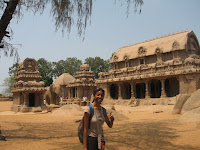 couldn't contact Mumbai immediately if anything happened. Anyway, I took two long bus rides to get to the Main Bus station and was on the next bus to Mahabalipuram. I saw the five rathas and the Shore temple while the guide explained that they are still rebuilding the town after the tsunami. Mahabalipuram is a fishing village with alot of scultures so its gorgeous to walk around and visit for just a day. But I wouldn't sleep there because the sleeping accomodations were very very sad..so I'm glad I left early. I was disappointed that I couldn't get to send an email to Mumbai when I got there because the internet was down in the entire village. But I just took a local bus and made my way to pondicherry.
Pondicherry is a relaxing place for a lot of people because they have a famous ashram where you can meditate and do yoga. Half of the town has a strong french influence so the architecture is very different from what I saw in other parts of South India. Apart from just spending the day resting and looking out at the beach, I didn't do much there which was nice because the crowded busses can take a lot out of a foreigner. I had to bargain HARD to get th e autorickshaw driver to drop me to the bus station at 3am so I could leave for Trichy.
Trichy has sooo many temples and I felt like sites to see there were endless. On my way to Trichy, I became friends with a university student Abirami who became my guide in Trichy. She invited me to her house and arranged for me to visit all the temples. It was great to eat a home cooked meal and to make a friend. She really took care of me. I saw many temples and they explained the history of each one of them. I have a picture of my favourite temple.
I did a couple more temple stops and hopped on the next bus to Madurai. I stayed in a very nice hotel in Madurai which was a little more expensive but a lot more comfortable than the places I had crashed before. I decided to take a day trip to Rameswaram where a bridge was built by Rama connecting to Sri Lanka. Needless to say that I was disappointed when I got there because it was a 7 kilometer walk and I was definitely not up for it especially when I had no guide and needed to get back to my hotel in madurai which was four hours away. I spent the day in the fishing village looking at the beach and then heading back to my hotel in Madurai in the evening.
I decided to check out even more temples in Madurai which I actually found to be less impressive than the ones in Trichy. Madurai is a lot more touristy than Trichy because it is definitely a center for many tourists even though the tourist attraction there is far less impressive. When I entered the Temple in Madurai I was alarmed to find an elephant inside which was all part of the attraction and so I was sure to be a good tourist and to take my picture with the elephant. However, the elephant saliva or snot or whatever it was made it very difficult for me to smile.
After that I made my way to Kanyakumari. The ride to Kanyakumari was quite an eventful, bumpy bus ride that took place in the wee hours of the morning. Eventful because I was made to sit "shotgun" on a little ledge connected to the windscreen as the bus tossed and turned and almost toppled over at every corner since our driver was moving at the speed of lightening. Anyway, I made it and got to Kanyakumari at 4am and stayed at the dingiest place I had ever seen for 200 rupees. I avoided the cockroches in my room by sleeping with one eye open and
 hugging my backpack REAL tight. Anyway, I got on the first boat jetty and was excited at what I felt was one of the most beautiful things I had ever seen. Kanyakumari is GORGEOUS! It is the southern most tip of India where the Bay of Bengal, the Arabian Sea and the Tibetian Ocean meet. Its wonderful and the colour of the water varies so the sea looks like a painting. I tried to watch the sunset but the monsoon season ensured that it was too cloudy... but I still thought that Sunset point was worth a visit.
I left Kanyakumari and entered Kerala. My first stop was Trivandrum and I found Kerala to be far more peaceful and no where near as hot as Tamil Nadu. Kerala just seemed less chaotic to me and so it was nice to be more relaxed. I spent a night of well-needed rest in Trivandrum before heading out to Fort Cochin to see the famous backwaters of Kerala. I liked it a lot but there was a Bengali family on the raft who insisted that the tour was way too boring and decided to cut the tour short and leave. I didn't mind because I was bored after the first hour but it was really quite a nice, peaceful ride. If you go to Kerala it is an absolute MUST-SEE! Its really peaceful. I also went to check out the Kathakhali dances, see some Chinese fishing and had an Ayurvedic massage which left my dreds incredibly oily. The oil from the massage was potent and when I entered my flight, the passenger beside me smiled and said: You just had an ayurvedic massage...and I nodded even though I was a bit embarrassed. Anyway, it was a nice ending to the trip and then I headed back to Mumbai. All in all, Southern India was a great trip.
I landed in Chennai (Madras) from Mumbai and when I saw what a horrific city it was, I decided I needed to get out FAST! Apparently I hopped into a 'three wheeler'/auto/rickshaw a little too quickly and lost my cell phone. That was the scary part because I
 couldn't contact Mumbai immediately if anything happened. Anyway, I took two long bus rides to get to the Main Bus station and was on the next bus to Mahabalipuram. I saw the five rathas and the Shore temple while the guide explained that they are still rebuilding the town after the tsunami. Mahabalipuram is a fishing village with alot of scultures so its gorgeous to walk around and visit for just a day. But I wouldn't sleep there because the sleeping accomodations were very very sad..so I'm glad I left early. I was disappointed that I couldn't get to send an email to Mumbai when I got there because the internet was down in the entire village. But I just took a local bus and made my way to pondicherry.
Pondicherry is a relaxing place for a lot of people because they have a famous ashram where you can meditate and do yoga. Half of the town has a strong french influence so the architecture is very different from what I saw in other parts of South India. Apart from just spending the day resting and looking out at the beach, I didn't do much there which was nice because the crowded busses can take a lot out of a foreigner. I had to bargain HARD to get th
 e autorickshaw driver to drop me to the bus station at 3am so I could leave for Trichy.
Trichy has sooo many temples and I felt like sites to see there were endless. On my way to Trichy, I became friends with a university student Abirami who became my guide in Trichy. She invited me to her house and arranged for me to visit all the temples. It was great to eat a home cooked meal and to make a friend. She really took care of me. I saw many temples and they explained the history of each one of them. I have a picture of my favourite temple.
I did a couple more temple stops and hopped on the next bus to Madurai. I stayed in a very nice hotel in Madurai which was a little more expensive but a lot more comfortable than the places I had crashed before. I decided to take a day trip to Rameswaram where a bridge was built by Rama connecting
 to Sri Lanka. Needless to say that I was disappointed when I got there because it was a 7 kilometer walk and I was definitely not up for it especially when I had no guide and needed to get back to my hotel in madurai which was four hours away. I spent the day in the fishing village looking at the beach and then heading back to my hotel in Madurai in the evening.
I decided to check out even more temples in Madurai which I actually found to be less impressive than the ones in Trichy.
 Madurai is a lot more touristy than Trichy because it is definitely a center for many tourists even though the tourist attraction there is far less impressive. When I entered the Temple in Madurai I was alarmed to find an elephant inside which was all part of the attraction and so I was sure to be a good tourist and to take my picture with the elephant. However, the elephant saliva or snot or whatever it was made it very difficult for me to smile.
After that I made my way to Kanyakumari. The ride to Kanyakumari was
 quite an eventful, bumpy bus ride that took place in the wee hours of the morning. Eventful because I was made to sit "shotgun" on a little ledge connected to the windscreen as the bus tossed and turned and almost toppled over at every corner since our driver was moving at the speed of lightening. Anyway, I made it and got to Kanyakumari at 4am and stayed at the dingiest place I had ever seen for 200 rupees. I avoided the cockroches in my room by sleeping with one eye open and
 hugging my backpack REAL tight. Anyway, I got on the first boat jetty and was excited at what I felt was one of the most beautiful things I had ever seen. Kanyakumari is GORGEOUS! It is the southern most tip of India where the Bay of Bengal, the Arabian Sea and the Tibetian Ocean meet. Its wonderful and the colour of the water varies so the sea looks like a painting. I tried to watch the sunset but the monsoon season ensured that it was too cloudy... but I still thought that Sunset point was worth a visit.
I left Kanyakumari and entered Kerala. My first stop was Trivandrum and I found Kerala to be far more peaceful and no where near as hot as Tamil Nadu. Kerala just seemed less chaotic to me and so it was nice to be more relaxed. I spent a night of well-needed rest in Trivandrum before heading out to Fort Cochin to see the famous backwaters of Kerala.
 I liked it a lot but there was a Bengali family on the raft who insisted that the tour was way too boring and decided to cut the tour short and leave. I didn't mind because I was bored after the first hour but it was really quite a nice, peaceful ride. If you go to Kerala it is an absolute MUST-SEE! Its really peaceful. I also went to check out the Kathakhali dances, see some Chinese fishing and had an Ayurvedic massage which left my dreds incredibly oily. The oil from the massage was potent and when I entered my flight, the passenger beside me smiled and said: You just had an ayurvedic massage...and I nodded even though I was a bit embarrassed. Anyway, it was a nice ending to the trip and then I headed back to Mumbai. All in all, Southern India was a great trip.
Wednesday, August 22, 2007
Monday, August 20, 2007
A reflection on Dharavi
I did a tour of Dharavi, one of Asia's largest slums, when I first got to Mumbai. I went with the expectation that it would be like Kibera (one of Africa's largest slum) which I visited when I was in Kenya three years ago but the two were less similar than I imagined they would be. Dharavi had a lot more small business enterprises than Kibera even though the general living conditions were about the same.
My guide was a male student, born and raised in Dharavi and explained that he was working as a tour guide to raise enough money to get his masters in commerce. Our tour consisted of visiting the small business enterprises that exist throughout the huge slum. It examined the local industry and livelihood of Dharavi in order to dispel the notion that its residents there are poor because they are 'lazy' or 'naturally prone to violence' and all the other stereotypes about poor people that we know exist everywhere. It also outlined the institutional problems with governmental involvement (or the lack thereof) in the slum.
Dharavi is made up of migrants from Gujurat, Tamil Nadu and different parts of Maharashtra so it was common to find people working with family members or people of the same ethnic group. The first small business enterprise I visited was the plastic recycling business. The residents of a part of Dharavi built a business where the womyn collect and clean the plastic, then the men work the machines to crush it, dry it and resell it to companies. The first obvious advantage of this business was the fact that it is so environmentally friendly and I was lucky enough to see all the machines and watch the whole process of recycling plastic. The second business enterprise that I saw, and for which Dharavi is known, is the leather industry. People were producing and using leather to make lap top bags, clothes, shoes and sold items to companies and store owners. The other two industries I looked at were the pottery and baking industries. The business were thriving to the extent that people actually had employment but the elite business class' exploitation of these businesses is common knowledge for the people of Dharavi. For example, the average person working in the leather industry would make only 18 rupees per bag while the buyers resell each bag for 118 rupees. The guide explained that there is little people can do about this because they are so desperate for any money they earn that they have little choice but to continue selling it to these buyers anyway.
The guide explained to me that some of the major challenges that Dharavi is facing apart from the exploitation of the buyers who benefit from the small business enterprises, have to do with the lack of investment on the government's part in developing the infrastructure of the slum. The government had pledged to build new buildings and homes for Dharavi residents but he explained that only the bottom floor of one or two of the new buildings were for slum dwellers and most buildings were put on the market for sale. He explained that the government's investment in the new buildings did not have Dharavi residents at heart and was really a way for the rich to make money. Also, when we went to his house, he told me that they were going to knock down his own home to build another building which he was sure would be too expensive for his family to rent anyway. He also explained that with the construction of the buildings came the destruction of a lot of the spaces for the small business enterprises to the detriment of people's livelihood and way of life.
He suggested that the government develop Dharavi by cleaning the sewage and re-organising their dumping systems. Also, while building homes for the residents is a basic necessity, any development of the infrastructure of Dharavi should compliment and sustain all local industry and business of the community.
My guide was a male student, born and raised in Dharavi and explained that he was working as a tour guide to raise enough money to get his masters in commerce. Our tour consisted of visiting the small business enterprises that exist throughout the huge slum. It examined the local industry and livelihood of Dharavi in order to dispel the notion that its residents there are poor because they are 'lazy' or 'naturally prone to violence' and all the other stereotypes about poor people that we know exist everywhere. It also outlined the institutional problems with governmental involvement (or the lack thereof) in the slum.
Dharavi is made up of migrants from Gujurat, Tamil Nadu and different parts of Maharashtra so it was common to find people working with family members or people of the same ethnic group. The first small business enterprise I visited was the plastic recycling business. The residents of a part of Dharavi built a business where the womyn collect and clean the plastic, then the men work the machines to crush it, dry it and resell it to companies. The first obvious advantage of this business was the fact that it is so environmentally friendly and I was lucky enough to see all the machines and watch the whole process of recycling plastic. The second business enterprise that I saw, and for which Dharavi is known, is the leather industry. People were producing and using leather to make lap top bags, clothes, shoes and sold items to companies and store owners. The other two industries I looked at were the pottery and baking industries. The business were thriving to the extent that people actually had employment but the elite business class' exploitation of these businesses is common knowledge for the people of Dharavi. For example, the average person working in the leather industry would make only 18 rupees per bag while the buyers resell each bag for 118 rupees. The guide explained that there is little people can do about this because they are so desperate for any money they earn that they have little choice but to continue selling it to these buyers anyway.
The guide explained to me that some of the major challenges that Dharavi is facing apart from the exploitation of the buyers who benefit from the small business enterprises, have to do with the lack of investment on the government's part in developing the infrastructure of the slum. The government had pledged to build new buildings and homes for Dharavi residents but he explained that only the bottom floor of one or two of the new buildings were for slum dwellers and most buildings were put on the market for sale. He explained that the government's investment in the new buildings did not have Dharavi residents at heart and was really a way for the rich to make money. Also, when we went to his house, he told me that they were going to knock down his own home to build another building which he was sure would be too expensive for his family to rent anyway. He also explained that with the construction of the buildings came the destruction of a lot of the spaces for the small business enterprises to the detriment of people's livelihood and way of life.
He suggested that the government develop Dharavi by cleaning the sewage and re-organising their dumping systems. Also, while building homes for the residents is a basic necessity, any development of the infrastructure of Dharavi should compliment and sustain all local industry and business of the community.
Subscribe to:
Posts (Atom)